
AI & Trading
Can You Make Money with AI Trading?
Use AI to research markets, build a repeatable trading process, and evaluate results after costs. Learn how Liquid Co-Invest fits into the workflow.

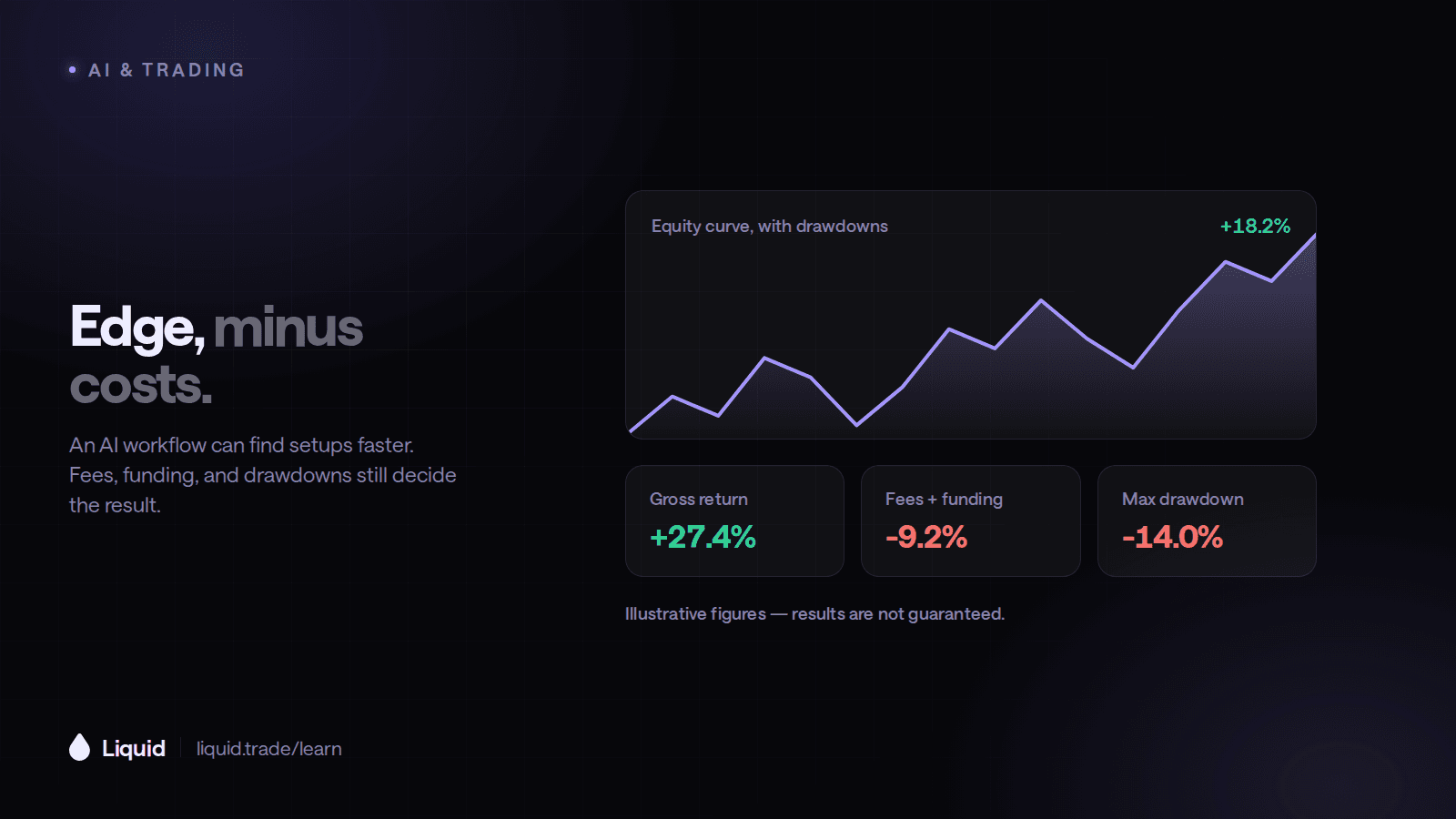
AI can support profitable trading through research, strategy development, and execution, but it does not guarantee returns. Results depend on market movement, entry and exit decisions, position size, execution, and costs. The useful starting point is a repeatable process whose results you can measure.
Liquid Co-Invest connects market research with account context and trade proposals. You can explore a thesis, review the proposed exposure, and practice the workflow in simulated trading before deciding how to use it live.
How Can I Make Money with AI?
AI can support income-producing work, such as building software or improving a service, and it can support investment research. Start with the skill or decision you want to improve. In a trading workflow, that might be interpreting market developments or consistently following a documented strategy.
For trading specifically, the useful question is: does AI improve a repeatable decision after accounting for costs and losses? That might mean finding relevant news faster, checking a calculation, documenting a strategy, or identifying a reason to skip a trade. It does not have to mean making more predictions.
A useful first goal is improving the process you can measure. Compare the time needed to review a market, the relevance of the sources gathered, and how consistently your trading rules are followed. Track these operational improvements alongside the financial results.
Does an AI Trading Bot Guarantee Profits?
No. The CFTC's advisory on AI trading bots warns against claims of unusually high or guaranteed returns. Evaluate a strategy using a complete record, its costs, and its behavior across different market conditions.
Track the size of wins and losses alongside win rate. For example, six $20 winners and four $15 losers produce $60 of gross profit over ten trades, with a 60% win rate. Subtract the applicable costs to calculate the net result. These illustrative figures show why several measurements belong in the same trading journal.
How Do I Calculate Trading Results After Costs?
Evaluate the result after entry and exit fees, spread, slippage, funding, and relevant software or model costs. Liquid publishes its fee schedule; the applicable rate depends on the product and route, so check the order details rather than assuming one headline rate covers every market.
Consider an illustrative $5,000 long position. A 1% favorable price move produces $50 before costs. If combined trading costs and slippage are $15 and the position pays $8 in funding, the net result is $27. With the same costs and a smaller 0.4% favorable move, the result would be a $3 loss. These are hypothetical assumptions, not a Liquid fee quote.
For perps, funding payments pass between opposite sides of the market and may be paid or received. Include the current rate and intended holding period in your plan, then record the actual payments when reviewing results.
Track position notional and supporting collateral separately. Leverage changes exposure relative to that collateral and magnifies gains and losses. Comparing similarly sized positions helps you evaluate the strategy itself rather than changes in position size.
How Do I Test Whether AI Improves My Trading?
Define the strategy before reviewing the outcome. Write down the market, entry condition, exit condition, maximum exposure, and situations where you will wait. Keep a dated version of the rules so you can connect each result to the plan that produced it.
Build a repeatable evaluation process
Record the original plan
Save the sources, assumptions, proposed trade, and reasons to reject it before the market moves.Test with realistic costs
Include fees, spread, funding, slippage, and the possibility that an order does not fill.Use new data
Evaluate the strategy on periods or observations that were not used to tune its rules.Practice the live workflow
Use simulation to check account mode, order sizing, confirmations, and position monitoring.Review the complete results
Measure net returns, drawdown, concentration, and consistency with the plan.
Compare with a simple baseline appropriate to the strategy. For a long-only crypto approach, compare its return and exposure with holding the relevant asset over the same period. This helps you see what the research and timing decisions contributed beyond the wider market move.
Use paper trading to rehearse research, order review, and position monitoring. Treat its results as simulated: live liquidity, slippage, latency, and decision-making can differ. Continue evaluating over time instead of projecting income from a short sample.
How Does Liquid Co-Invest Fit into This Process?
Co-Invest can help assemble market context and trade proposals; Liquid documents a simulated mode for practicing with market data. Start with the beginner walkthrough and keep a record of what you asked, what it observed, and what you decided. Co-Invest documentation.
For ongoing monitoring and enabled execution, Co-Invest Computer offers a separate workflow from standard user-confirmed Co-Invest. Define the strategy, execution mode, and limits using the AI agent portfolio management guide, then rehearse the process in simulation or staged mode.
Try Co-Invest with one research question and a paper trading plan. Keep the sources, proposed orders, and outcomes together, then use that record to refine your process and decide what to explore next.
Educational content only — not investment advice. Trading perpetual futures involves substantial risk and may not be suitable for every investor. Past performance is not indicative of future results.
Keep reading
All articles →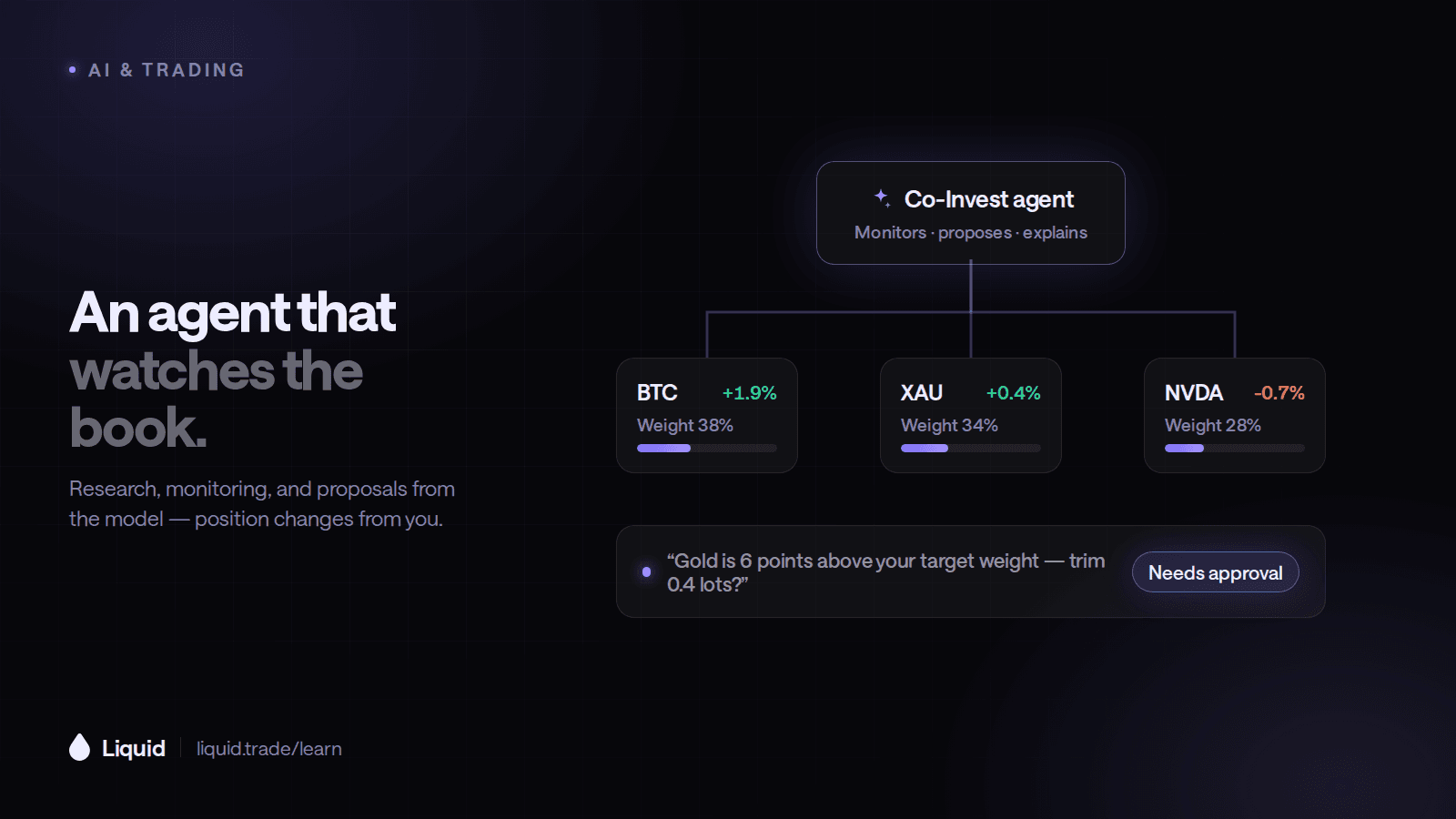
AI & Trading
How to Let an AI Agent Help Manage Your Trading Portfolio
Define what an AI agent may research, propose, and execute. Compare user-confirmed Co-Invest with autonomous Co-Invest Computer and build clear risk limits.
AI & Trading
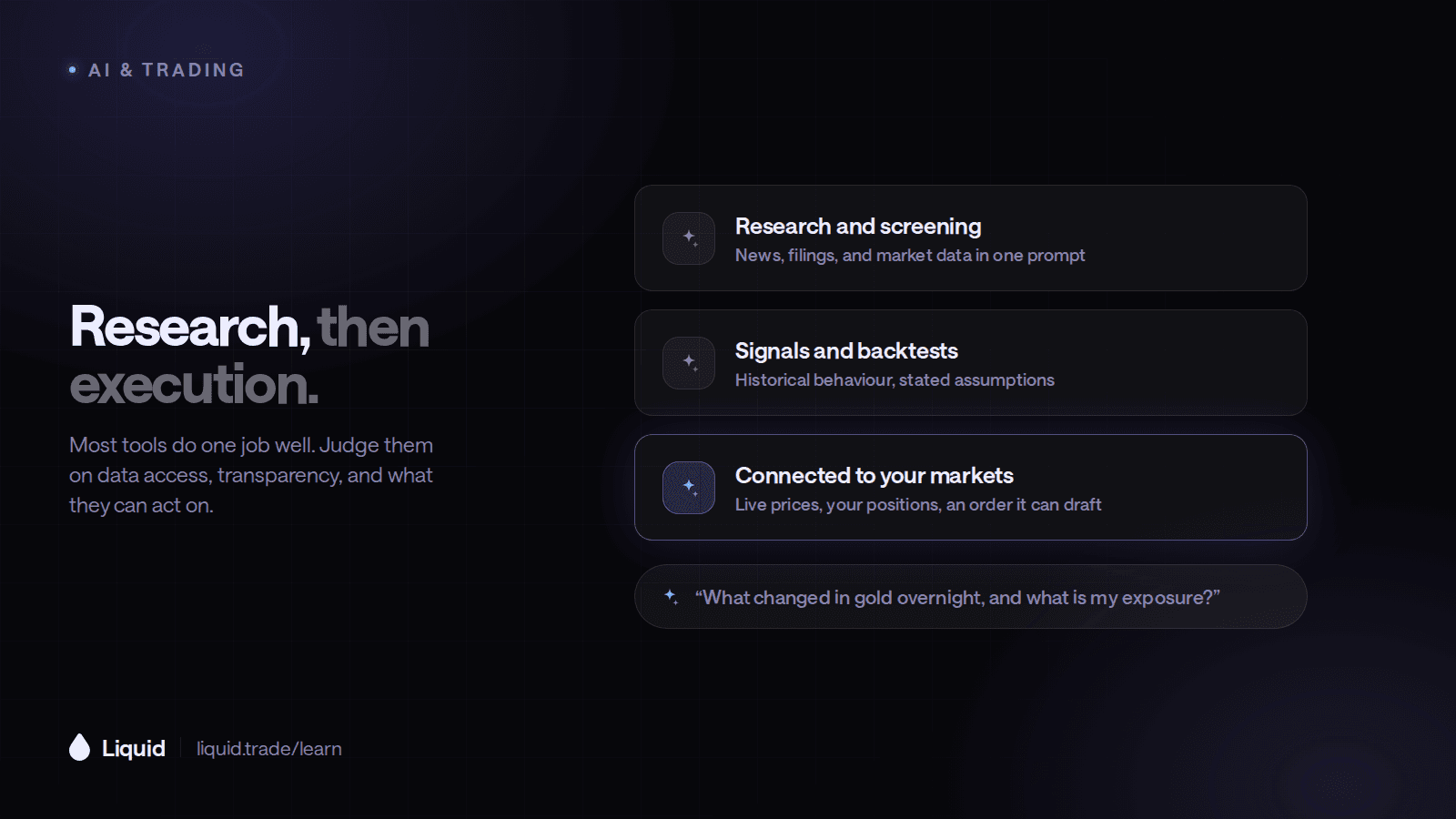
The Best AI Tools for Market Research and Trading: How to Choose
Compare AI research assistants, account-aware trading tools, backtesting platforms, and autonomous agents by what they actually do.
AI & Trading
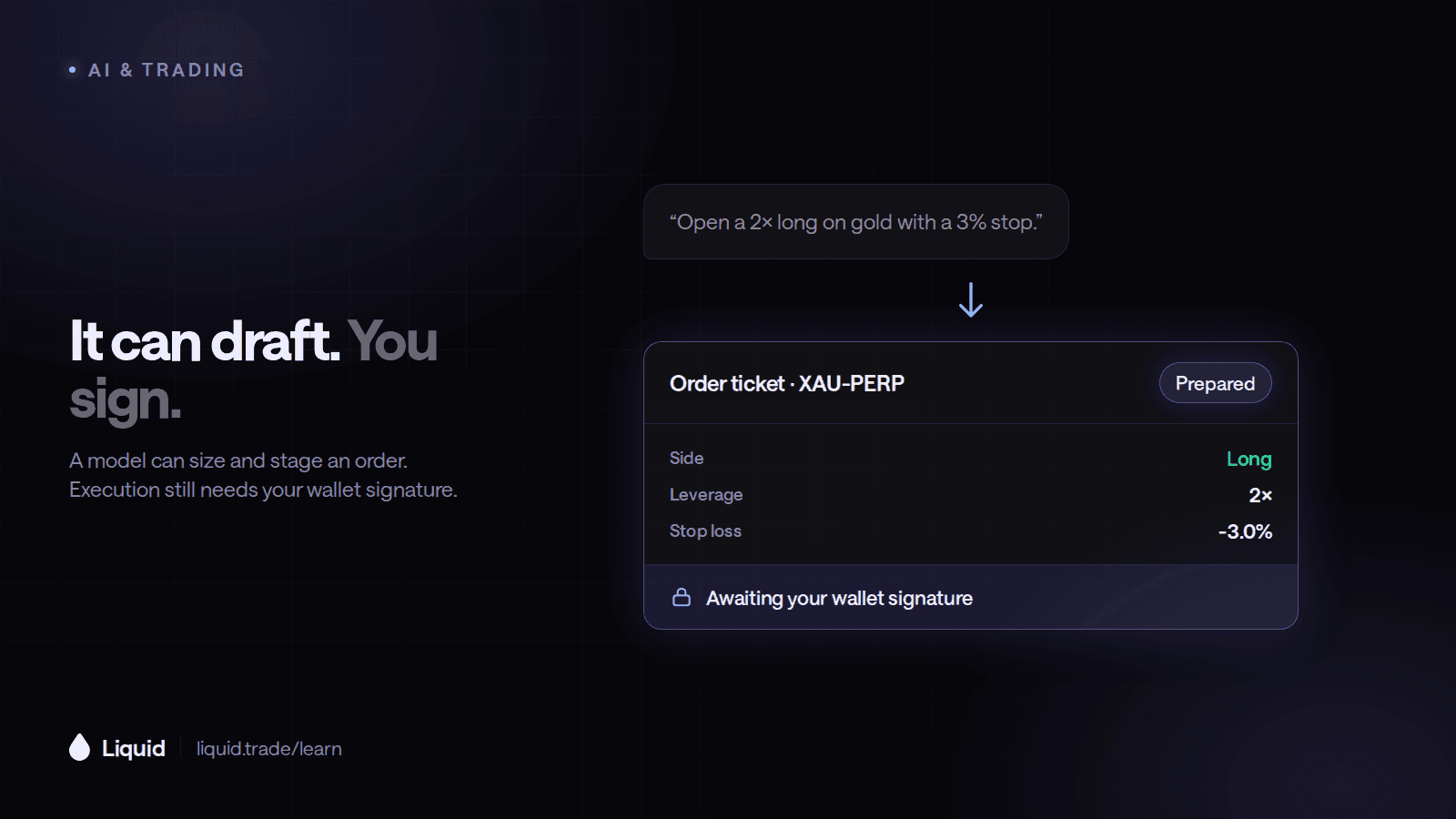
Can You Use ChatGPT to Place Trades?
ChatGPT needs a connected trading service to turn a conversation into an order. Learn how Liquid Co-Invest works and what to check before confirming.
Put what you learned to work.
Trade crypto, stocks, commodities, FX and pre-IPO names — with multipliers of up to 50×, depending on the market, and instant settlement.