
Education
What Are Funding Rates?
How funding rates keep perpetual futures prices aligned with spot markets — what they are, how they work, and how traders can use them strategically.

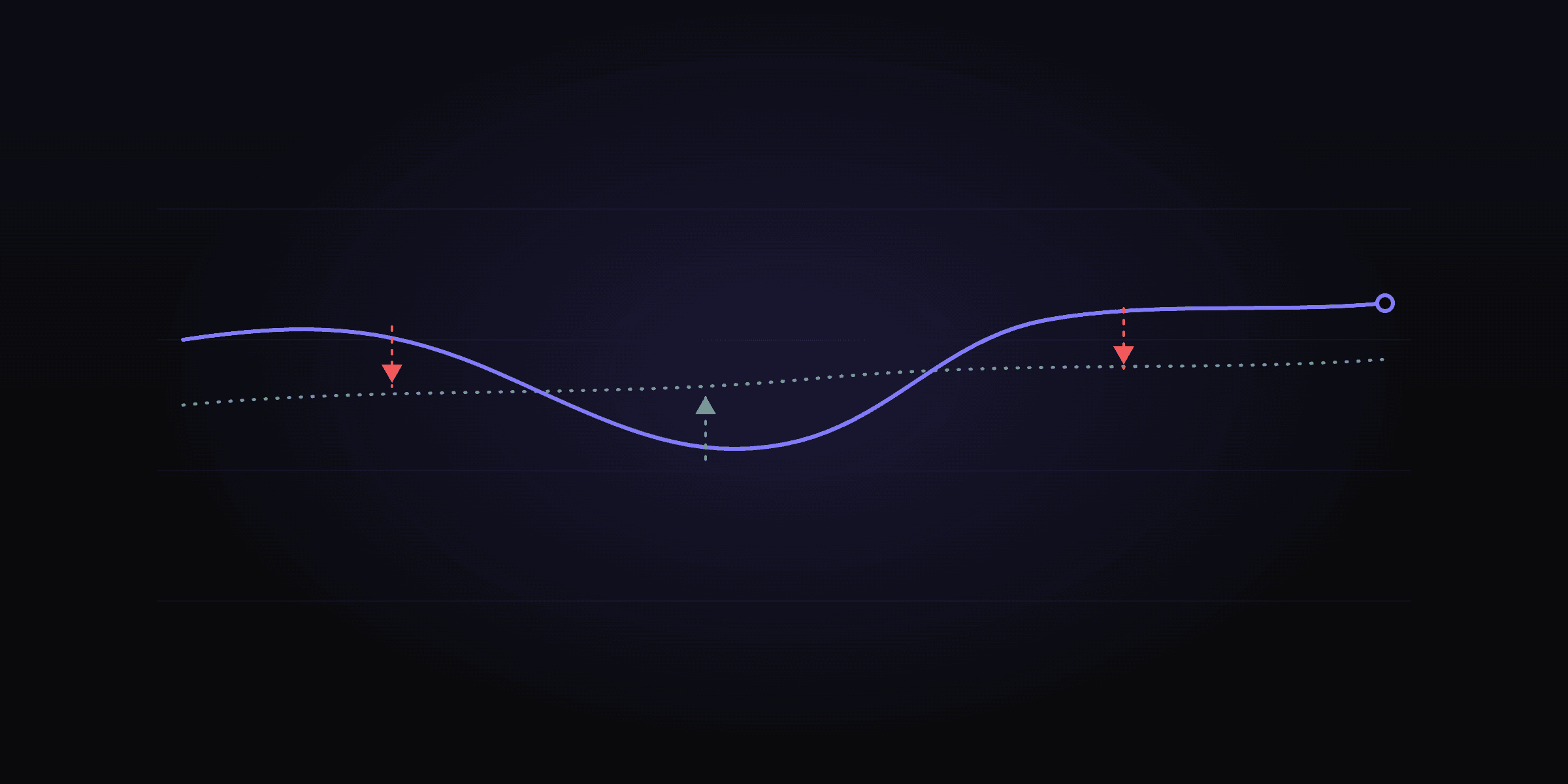
Funding is the periodic payment that keeps perpetual futures anchored to their reference markets. Sometimes you pay it. Sometimes you receive it. Either way, it directly affects PnL, liquidation risk, and the true cost of holding a perp position.
Funding is not a trading fee paid to the platform. It is generally a peer-to-peer payment between traders on opposite sides of the market.
Who pays whom
P2P
Traders, not the venue
Typical interval
8h
Some venues hourly; varies
What it's based on
Notional
Position size, not posted margin
What it reveals
Sentiment
Where positioning is crowded
Why Funding Exists
Perpetual futures do not expire. That is what makes them useful — you can hold exposure without rolling a dated futures contract.
But no expiry creates a problem. If there is no settlement date forcing the contract price and the reference price to converge, a perp could drift far away from the underlying market. Funding is the incentive mechanism that pulls it back.
Funding pulls the perp back toward reference
Settles every 8h
+0.000%
Longs pay shorts — perp trading rich to reference.
When a perp trades above its reference, funding usually turns positive — longs pay shorts. That makes long exposure more expensive and short exposure more attractive. When a perp trades below its reference, funding usually turns negative — shorts pay longs.
Positive vs. Negative Funding
Same position, two funding regimes
Positive funding · long
You pay
Perp is trading rich. Longs are aggressively paying to stay in. You're on the crowded side — and the holding cost is real.
- Direction
- Long
- Funding sign
- +
- Cash flow
- Outflow
- Signal
- Crowded long
Positive funding · short
You collect
Same regime, opposite side. Shorts receive the funding payment from longs. The carry can subsidise the position even when price is flat.
- Direction
- Short
- Funding sign
- +
- Cash flow
- Inflow
- Signal
- Carry available
The payment happens automatically at funding timestamps. If you hold a position at the timestamp, the payment is credited or debited according to your side, position size, and the funding rate for that interval.
How Funding Is Calculated
Exact formulas vary by venue, but most funding models have two broad components:
- Premium component — measures whether the perp is trading above or below the oracle/reference price.
- Interest or adjustment component — accounts for baseline carrying costs or clamps the final rate so short-lived dislocations do not produce unstable funding.
Many venues calculate the premium using fair or impact prices rather than a single last trade. That helps avoid funding rates being distorted by one small print in a thin order book.
Single-interval funding payment
Funding payment = $20,000 × 0.01%
Paid (+) or received (−)
$2.00
When Does Funding Settle?
Funding schedules vary by platform. Many perp venues quote funding on an 8-hour basis. Some settle every 8 hours. Others calculate the formula on an 8-hour convention but settle smaller proportional payments more frequently, such as hourly.
Common funding schedules
| Schedule | Quoted rate | Settlement | Practical effect |
|---|---|---|---|
| Hourly | ~1/8 of the 8h rate | Every hour | Hard to game by timing |
| 8-hour | Full rate | Three times per day | Trade-around-print is possible |
| Mixed (8h convention, hourly drip) | 1/8 each hour | Smooth, hourly | Best of both — Liquid uses this on most pairs |
The practical rule is simple: know the funding schedule on the venue you are trading. Open and close between funding timestamps and you may skip that payment. Hold through a timestamp and funding applies.
Why Small Funding Rates Can Matter
Funding looks tiny because it is quoted as a percentage of notional. But leveraged traders feel it through margin.
Funding as a Sentiment Signal
Funding can tell you where positioning is crowded.
Very high positive funding often means longs are aggressively paying to stay in the trade. That can happen during strong uptrends, but it can also signal a crowded long setup vulnerable to a pullback.
Very negative funding often means shorts are crowded. That can happen during downtrends, but it can also set up a short squeeze if price reclaims key levels and shorts are forced to cover.
Funding is not a standalone trading signal. It does not predict the future. It tells you the cost of holding a side and gives a read on market positioning.
Funding Trades and Basis Risk
Some traders try to collect funding while hedging price exposure — a cash-and-carry trade.
A typical positive-funding carry setup
Spot long the asset
Buy the underlying on a spot venue. Your spot exposure is delta-positive.Short the perp with equal notional
Open a short perp position with notional matching your spot long. Net directional exposure is roughly zero.Collect funding from longs
While funding is positive, the short leg receives the funding payment every interval. That's the yield.Manage the carry over time
Funding can flip. Basis can widen. Liquidation can hit the perp leg if margin is too thin. See margin mode and liquidation.
How Funding Affects Stop Losses and Liquidation
Funding payments change account equity. If you are paying funding, your margin cushion shrinks over time. That can bring your liquidation price closer even if the market price has not moved much.
For swing trades, your stop and take-profit plan should account for expected funding payments, current funding direction, whether funding is likely to remain stable, and how much funding affects margin at your chosen leverage.
If a position only works when funding stays favourable, it is not just a directional trade — it is also a carry trade.
Quick Reference
- Positive funding: longs usually pay shorts.
- Negative funding: shorts usually pay longs.
- Funding is not a platform fee: it is generally exchanged between traders.
- Funding is based on notional: not just posted margin.
- Frequency varies: hourly and 8-hour models both exist.
- High funding is information: it can reveal crowded positioning and carry cost.
Further Reading
- Liquid docs: funding rates
- Liquid docs: fees
- Liquid docs: liquidations
- What Is Liquidation and How to Manage It
Trade Perps on Liquid
Liquid shows funding alongside position risk so you can understand the cost or credit of holding a trade.
- Create your account. Sign up with email or connect a wallet.
- Fund your account. Use supported funding methods or crypto deposits.
- Check funding before entry. Know whether you are paying or receiving.
- Monitor over time. Funding can change quickly when positioning becomes crowded.
Frequently Asked Questions
What is a funding rate in crypto trading?
A funding rate is a periodic payment exchanged between traders holding long and short perpetual futures positions. It keeps the perp price anchored to the underlying spot market. When the perp trades above spot, longs pay shorts; when it trades below, shorts pay longs.
How often are funding rates paid?
On Liquid, funding settles every hour. The rate is quoted on an 8-hour convention but paid in smaller hourly increments — so you never go a full 8 hours without settlement. This hourly drip makes it harder to game funding timestamps and smooths the cash flow for both sides of the trade.
Can you make money from funding rates?
Yes. Traders can earn funding by taking the less crowded side of the market. When funding is positive, shorts collect payments from longs. Some strategies — called carry trades or funding farming — specifically target this income, often hedging the directional risk with a spot position.
How is the funding rate calculated?
The exact formula varies by exchange but typically has two components: a premium component measuring the gap between the perp and oracle price, and an interest or clamping component that prevents erratic swings. The payment itself equals position notional multiplied by the rate.
Does funding affect my liquidation price?
Yes. Funding payments are debited directly from your margin. If you are consistently paying funding over time, your effective collateral decreases, bringing your liquidation price closer. Monitoring accumulated funding costs is essential for managing leveraged positions.
Educational content only — not investment advice. Trading perpetual futures involves substantial risk and may not be suitable for every investor. Past performance is not indicative of future results.
Keep reading
All articles →Education
How to Trade Against the US Dollar With Leverage
To trade against the dollar, choose a USD currency pair, take the side that matches your dollar view, and size the leverage from your risk—not the maximum available.
Education
You Can Now Give Grok Bot Your Trading Account
Co-Invest just connected to Grok Bot through MCP, so xAI's agent can analyze your portfolio, tell you about the market, and place trades on Liquid without you needing to touch the dashboard.

Education
How to Install Co-Invest in Claude and ChatGPT
A step-by-step setup guide for Co-Invest, the Liquid trading connector for Claude and ChatGPT. Connect it, fund your account, start in paper mode, and place your first trade from a conversation.
Put what you learned to work.
Trade crypto, stocks, commodities, FX and pre-IPO names — with multipliers of up to 50×, depending on the market, and instant settlement.