
Education
Cross Margin vs Isolated Margin Explained
The key differences between cross margin and isolated margin — how each mode works, when to use them, and how your choice affects liquidation risk.

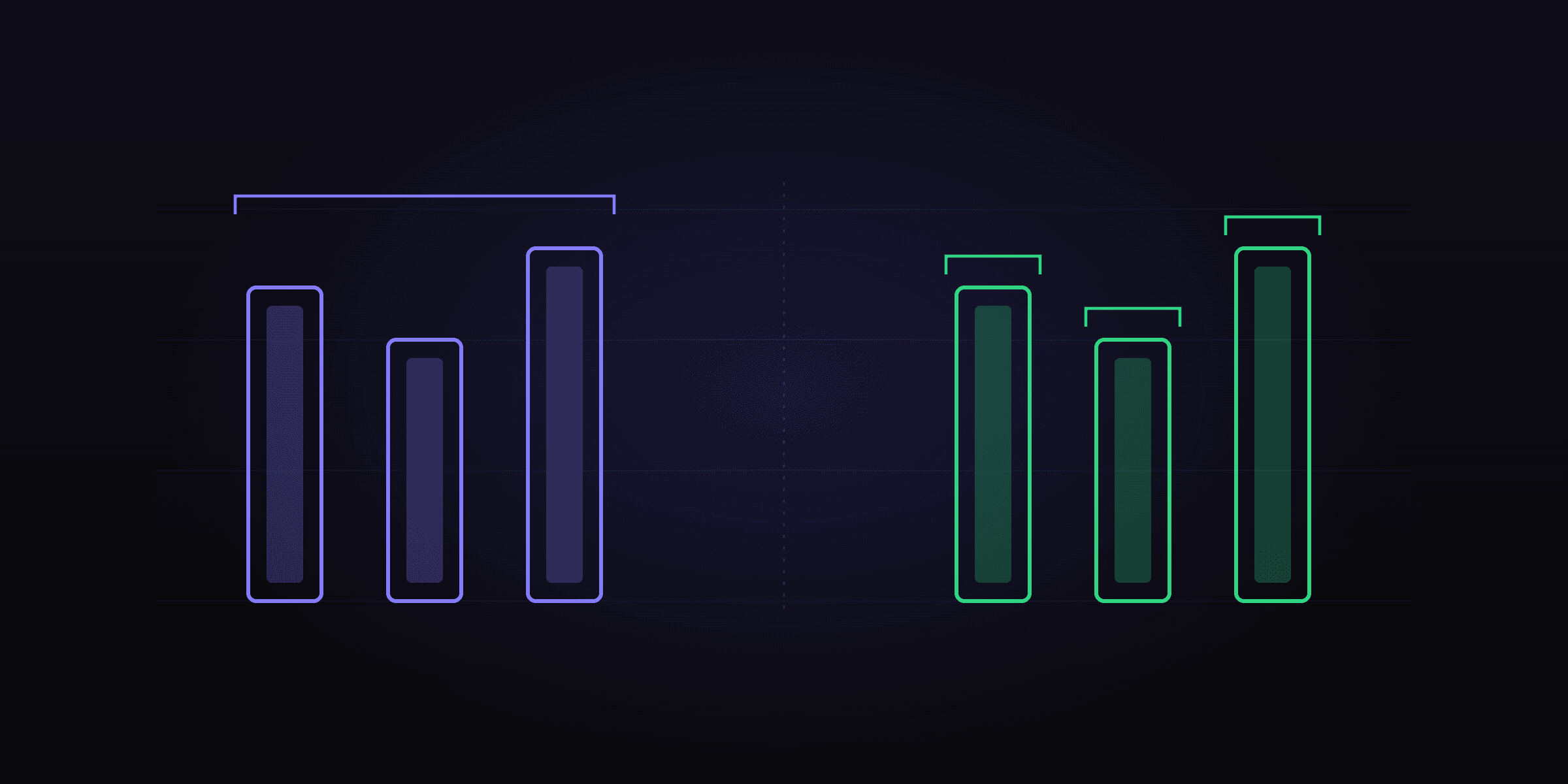
When you open a leveraged perp position, your margin mode decides what collateral can be used to support the trade. That choice can matter as much as your leverage.
Cross margin and isolated margin are not just interface settings. They define whether risk is pooled across your account or contained to one position — and that difference rewrites your liquidation profile entirely.
Isolated risk
Walled
Loss capped at the position's posted margin
Cross risk
Pooled
Whole account backs every open position
Cross liq distance
Further
More cushion on any one trade
Cross failure mode
Contagion
One bad trade can take the rest with it
The Core Difference
Isolated margin assigns collateral to a specific position. If that position goes badly, the loss is generally limited to the margin allocated to that position.
Cross margin uses a shared collateral pool across eligible positions. Profits, losses, and available account equity can support multiple positions at once.
Same market. Same entry. Same leverage. Same direction. Different margin mode → different liquidation profile.
A losing ETH trade drains…
Account collateral
- Total posted
- $5,000
- Trade loss
- −$2,000
- Remaining
- $3,000
Positions
- ETH long (the loser)$2,000
- BTC short$1,500
- SOL long$1,500
Cross margin pools collateral — the ETH loss draws from the same well that supports BTC and SOL. Better survival on any one trade, more contagion when one goes badly.
Isolated Margin · Defined Position Risk
With isolated margin, you decide how much collateral to commit to one trade.
Isolated example — $5,000 account, 10× ETH long
Effective leverage = $5,000 ÷ $500
On-trade leverage
10×
If ETH moves far enough against you, the position can be liquidated and the assigned isolated margin is at risk. Your remaining account balance is not supposed to directly support that position unless you manually add more margin.
That makes isolated margin useful when you want a clear risk boundary.
Cross Margin · Shared Collateral
With cross margin, eligible positions share account-level collateral. The same $5,000 account backing the same $5,000 ETH long has access to the full pool — so the liquidation price moves further away.
That extra room is useful — but it comes with a tradeoff. If ETH keeps falling, the loss can consume collateral that was backing the rest of your account.
Same losing trade, two outcomes
Isolated — walled off
ETH liquidated
ETH crashes 10%. The position hits maintenance margin and is liquidated. The other two trades are untouched. Total damage: the $500 isolated margin.
- ETH outcome
- Liquidated
- BTC short
- Unaffected
- SOL long
- Unaffected
- Account loss
- −$500
Cross — pooled, survives
ETH still open
Same 10% crash. The shared $5,000 pool absorbs the unrealised loss. ETH stays open — but account equity drops and every other position is now closer to its own liquidation threshold.
- ETH outcome
- Still open
- BTC short
- Cushion eroded
- SOL long
- Cushion eroded
- Account loss
- −$1,500 unrealised
Cross margin can make liquidation less likely on one position, but more damaging if account-level risk is not controlled.
Why Liquidation Price Changes
Liquidation depends on equity, maintenance margin, mark price, fees, funding, and margin mode. The mode is what changes which equity number the engine looks at.
What the liquidation engine watches under each mode
| Isolated | Cross | |
|---|---|---|
| Equity considered | Position-assigned margin only | Account-level equity |
| Per-trade cushion | Smaller | Larger |
| Liquidations triggered | More frequent, position-level | Less frequent, account-level |
| Blast radius | Contained | Whole account |
| Who survives a bad trade | The other positions | Maybe none of them |
The practical difference: isolated margin trades more frequent position-level liquidations for a smaller blast radius. Cross margin does the opposite.
When Isolated Margin Makes Sense
Reach for isolated when…
You want defined risk
You know exactly how much margin is committed to the trade — and you can lose it without losing anything else.You're testing a strategy
A failed experiment should not threaten unrelated positions.You're trading volatile assets
Isolated margin prevents one fast move from consuming your whole collateral pool — think thin altcoins, pre-IPO names, or event-driven stock perps.You run multiple unrelated trades
A short-term ETH idea should not drain collateral from a separate BTC or stock-perp setup.
For many traders, isolated margin is the cleaner default because it forces every position to stand on its own.
When Cross Margin Makes Sense
Reach for cross when…
You manage a portfolio, not one-off trades
Profits on one position can offset losses on another. The pool is the point.You're hedging
A long and short pair can be managed with shared collateral when the relationship is intentional and you understand the basis risk.You need capital efficiency
Avoid locking separate collateral pools behind every position.You actively monitor account-level risk
Cross margin requires watching total maintenance margin, not just one liquidation price.
Cross margin is not automatically more advanced. It is less forgiving if you ignore the full account.
Multi-Venue Margin Can Vary
Can You Switch Margin Modes?
This depends on the platform and the venue. Some platforms let you switch margin mode before opening a position but restrict changes afterward. Others let you adjust margin on an open isolated position, change leverage settings, or remove margin if requirements remain satisfied.
Do not assume you can always convert a live position from isolated to cross or back again. Check before entry — especially for large or event-driven trades.
The Simple Framework
Further Reading
- Liquid docs: leverage and margin modes
- Liquid docs: liquidations
- What Is Liquidation and How to Manage It
Trade Perps on Liquid
Liquid lets you choose margin mode with the liquidation impact visible before confirmation.
- Create your account. Sign up with email or connect a wallet.
- Fund your account. Use supported funding methods or crypto deposits.
- Choose margin mode intentionally. Use isolated for defined position risk or cross for managed account-level risk.
- Monitor collateral. Margin mode can change how quickly one trade affects everything else.
Frequently Asked Questions
What is cross margin?
Cross margin pools your entire account balance as collateral for all open positions. This gives each position a wider buffer against liquidation, since unrealized profits on one trade can offset unrealized losses on another. The trade-off is that a single bad position can draw down your entire account.
What is isolated margin?
Isolated margin assigns a fixed amount of collateral to each individual position. Your maximum loss on that position is limited to the assigned margin. Other positions and your remaining account balance are unaffected if the isolated position gets liquidated.
Which margin mode is better for beginners?
Isolated margin is generally safer for beginners because it caps the risk per trade. You know exactly how much you can lose before entering the position. Cross margin requires more active portfolio management since all positions share the same collateral pool.
Can you switch between cross and isolated margin?
Most platforms allow switching margin modes, but only when you have no open positions in the pair you want to change. Some venues require switching the entire account mode; others support per-position margin mode selection. Check your platform's specific rules before assuming you can switch mid-trade.
How does margin mode affect liquidation price?
In cross margin, your liquidation price is further from your entry because your full account balance supports the position. In isolated margin, the liquidation price is closer because only the assigned collateral counts. Cross margin is more capital-efficient but exposes more funds to risk.
Educational content only — not investment advice. Trading perpetual futures involves substantial risk and may not be suitable for every investor. Past performance is not indicative of future results.
Keep reading
All articles →Education
How to Trade Against the US Dollar With Leverage
To trade against the dollar, choose a USD currency pair, take the side that matches your dollar view, and size the leverage from your risk—not the maximum available.
Education
You Can Now Give Grok Bot Your Trading Account
Co-Invest just connected to Grok Bot through MCP, so xAI's agent can analyze your portfolio, tell you about the market, and place trades on Liquid without you needing to touch the dashboard.

Education
How to Install Co-Invest in Claude and ChatGPT
A step-by-step setup guide for Co-Invest, the Liquid trading connector for Claude and ChatGPT. Connect it, fund your account, start in paper mode, and place your first trade from a conversation.
Put what you learned to work.
Trade crypto, stocks, commodities, FX and pre-IPO names — with multipliers of up to 50×, depending on the market, and instant settlement.