
Pre-IPO Perps
How SpaceX Perps Work
SpaceX listed on Nasdaq as SPCX on June 12, 2026. The Liquid perp now tracks the listed stock, so here is how the contract, the reference price, and the risks changed after the IPO.


SpaceX is no longer a private company. On June 12, 2026, Space Exploration Technologies Corp. listed on Nasdaq under the ticker SPCX. The IPO priced at $135 per share, valuing the company at roughly $1.8 trillion, and the stock closed its first session around $161.
That changes what the SpaceX perp on Liquid is. Before the listing it needed a private-market oracle. Now it tracks an ordinary exchange tape, the same way the TSLA or NVDA perps do.
If you want to trade the market directly, you can open SpaceX perps on Liquid.
Nasdaq ticker
SPCX
Listed June 12, 2026
IPO price
$135
About $1.8T valuation at pricing
First-day close
~$161
Roughly 19% above the IPO price
Reference price
Live tape
Public exchange data, updated continuously
What Changed at the Listing
Before June 12, SpaceX pricing was a private-market problem: tender offers, secondary transactions, institutional marks, broker indications, and the S-1 the company filed on May 20, 2026. The perp needed an oracle that triangulated those inputs because there was no continuous public price.
After the listing, there is. The reference price is now the Nasdaq market for SPCX.
The reference price, before and after the listing
Scroll horizontally to compare
| Input class | Before listing | After listing |
|---|---|---|
| Primary reference | Private-market triangulation | Nasdaq SPCX tape |
| Update frequency | Days to weeks | Continuous during market hours |
| Audited financials | S-1 disclosures | Ongoing public filings |
| Closing price | None | Regulated daily close |
| Secondary marks and tender offers | Core input | Historical context only |
So the current state is:
- SpaceX is a listed public company.
- The SPCX perp on Liquid tracks the exchange price, not a private-market estimate.
- Pre-IPO inputs such as Nasdaq Private Market data are no longer part of the reference.
- The perp can still trade when Nasdaq is closed, so the price can move on news before the stock reopens.
A Perp Tracks Price Exposure, Not Share Ownership
When someone trades SpaceX perps on Liquid, they are not buying SpaceX shares.
They are taking a synthetic long or short position on the SPCX price. The contract does not give ownership of SpaceX common stock, voting rights, dividends, or any other shareholder rights. That was true before the IPO and it is still true now.
How the Perp Trades Around the Listed Price
The market has two layers:
- Reference layer: the Nasdaq price for SPCX sets the anchor.
- Trading layer: users trade the perp continuously around that anchor.
How the Transition Was Handled
A perp on a company going public has to be explicit about when the reference changes and how the two regimes are stitched together.
Reference regime, pre-IPO vs. post-listing
Pre-IPO regime (until June 12, 2026)
Private inputs
Primary rounds, secondaries, tender offers, Nasdaq Private Market data, mutual fund marks, S-1 disclosures. The oracle smoothed across multiple signals and updated episodically.
- Dominant input
- Private-market triangulation
- Update frequency
- Days to weeks
Post-listing regime (current)
Public tape
Nasdaq is the primary reference. Continuous trades, transparent volume, regulated closing price. Pre-IPO inputs are historical context, not an input.
- Dominant input
- Exchange tape
- Update frequency
- Continuous
The IPO priced at $135 and the first-day close was around $161, so the private marks and the public market did diverge, which is exactly why the reference had to migrate rather than blend the two.
Why Traders Care About SpaceX Perps
SpaceX has the ingredients that make a stock perp busy: global recognition, intense investor and trader demand, a fresh public listing with a short trading history, and high uncertainty around valuation, growth, and risk.
Those ingredients create two-sided interest. Bulls can express the view that SPCX should keep rerating higher. Bears can express the view that a $1.8 trillion IPO valuation and a first-day pop already price in too much. Hedgers can manage related exposure around space, defense, satellites, broadband, AI infrastructure, or Elon-Musk-linked assets.
Available multipliers vary by market, account, and jurisdiction. See the live order ticket for the current maximum before you size a position.
Key Risks
Further Reading
- SpaceX Form S-1 filed with the SEC on May 20, 2026
- Liquid docs: funding rates
- Liquid docs: liquidations
- How Anthropic Perps Work
- How OpenAI Perps Work
Trade SpaceX Perps on Liquid
SpaceX perps are a way to trade long or short exposure to the listed SPCX price with leverage. They are not SpaceX shares.
Frequently Asked Questions
Is SpaceX a public company now?
Yes. SpaceX listed on Nasdaq on June 12, 2026 under the ticker SPCX. The IPO priced at $135 per share, valuing the company at roughly $1.8 trillion, and the stock closed its first day around $161. Before the listing, SpaceX exposure was a private-market pricing problem; it is now an ordinary listed stock with a continuous exchange tape.
What does the SpaceX perp on Liquid track?
The SPCX perp on Liquid tracks the price of SpaceX common stock as it trades on Nasdaq. You gain long or short price exposure through a cash-settled perpetual contract. You do not own shares, and you have no voting or other shareholder rights; you profit or lose based on price movement.
How did the SpaceX perp handle the IPO transition?
Before the listing, the reference price came from private-market inputs such as secondary transactions, tender offers, institutional marks, and SEC filing data. Once public trading began, the reference migrated to the listed stock price, which updates continuously rather than episodically.
What leverage is available on SpaceX perps?
Available multipliers on SpaceX perpetuals vary by market, account, and jurisdiction. Check the live order ticket for the current maximum. Leverage magnifies losses and liquidation risk.
What are the risks of trading SpaceX perps?
Key risks include gaps when Nasdaq is closed and news lands outside regular hours, funding costs when one side is crowded, and the usual liquidation risk of leveraged perpetuals. Leverage amplifies all of these. Size positions conservatively and set a stop before you enter.
Educational content only — not investment advice. Trading perpetual futures involves substantial risk and may not be suitable for every investor. Past performance is not indicative of future results.
Keep reading
All articles →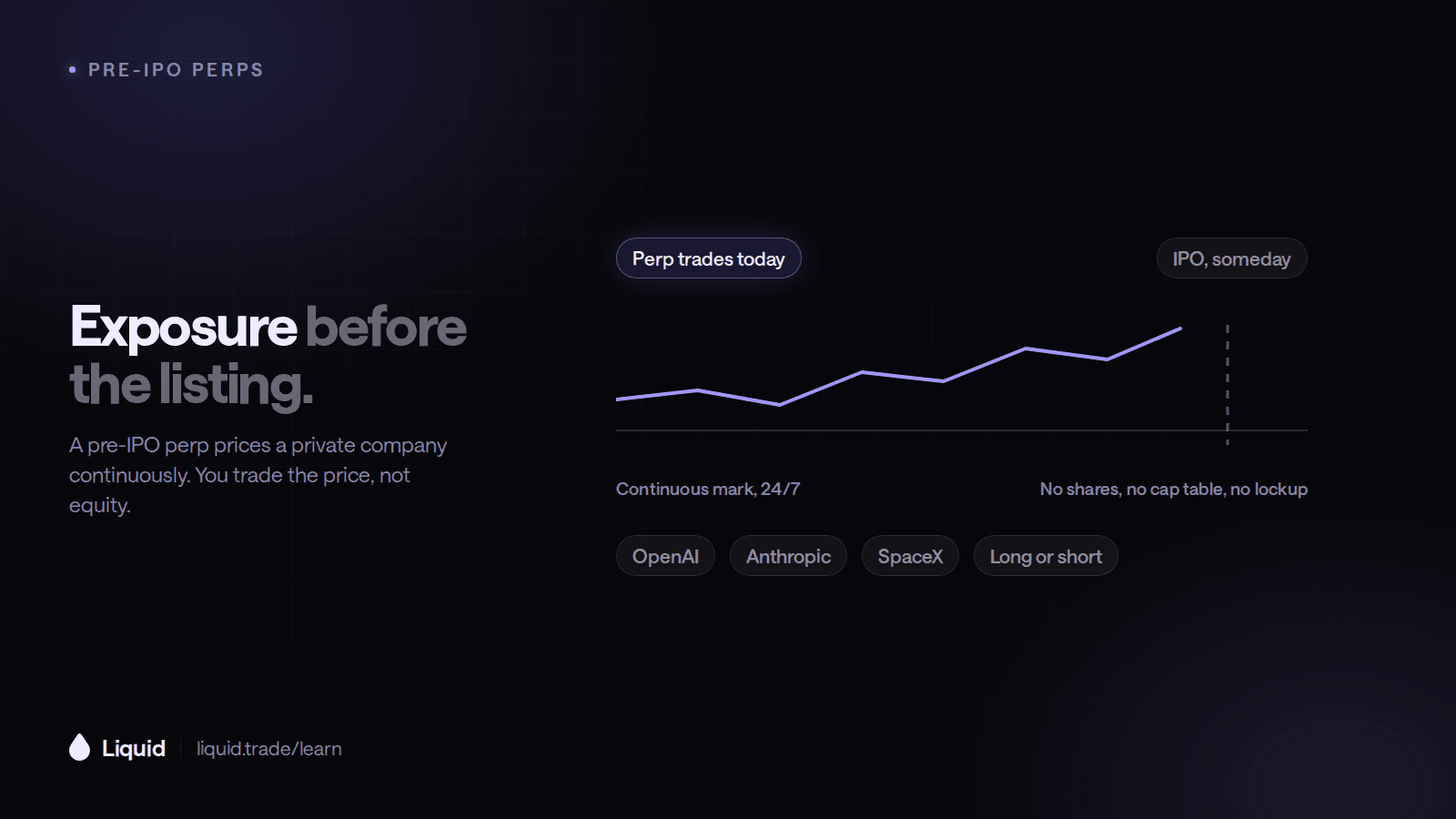
Pre-IPO Perps
How to Trade Pre-IPO Perpetual Futures
Explore OpenAI and Anthropic exposure on Liquid, with a guide to private-company reference prices, long and short positions, and funding.
Pre-IPO Perps
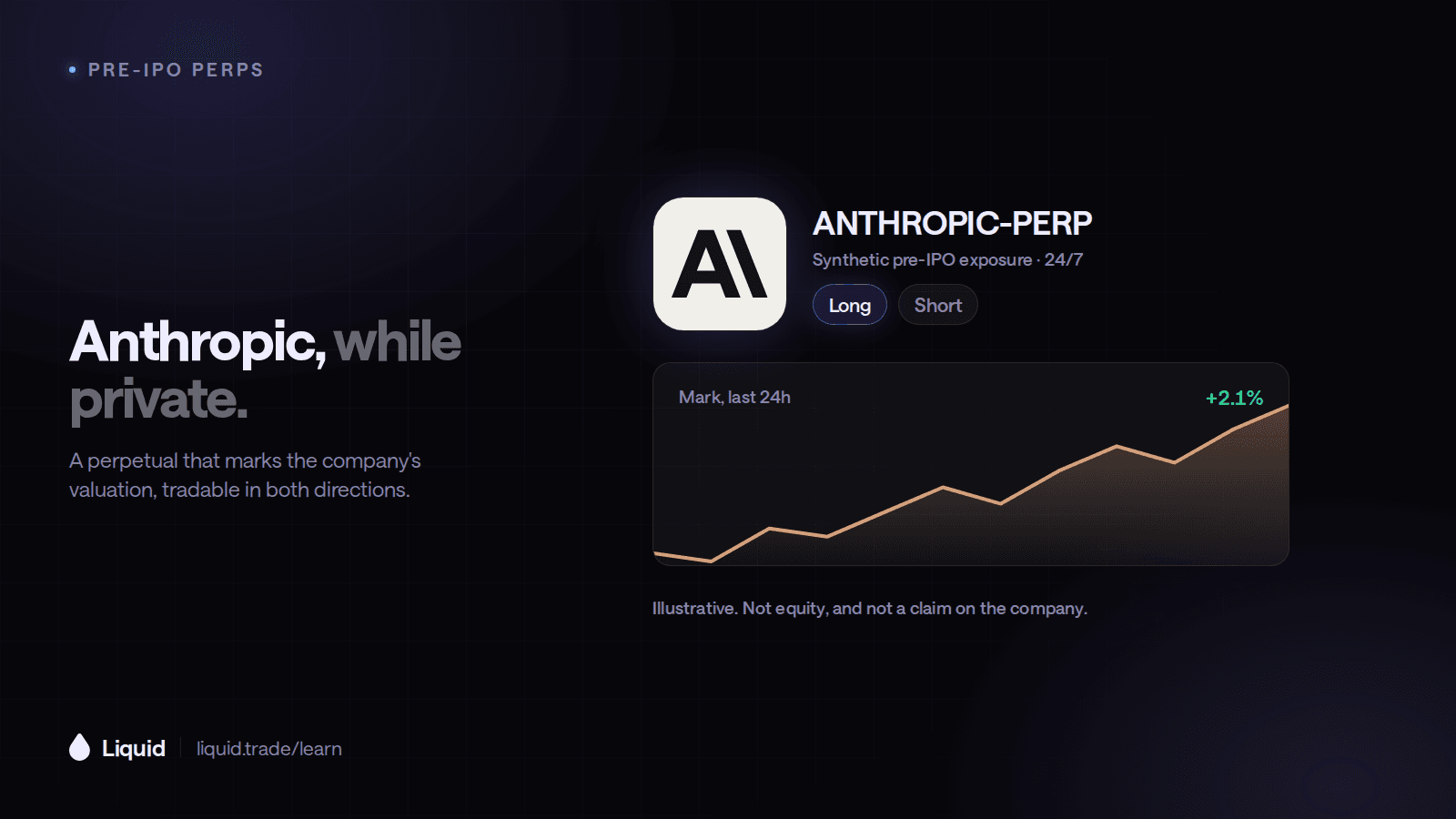
How to Trade Anthropic Pre-IPO Exposure
Explore long and short Anthropic exposure through Liquid’s ANTH perpetual, with a worked valuation example and a practical trading checklist.
Pre-IPO Perps
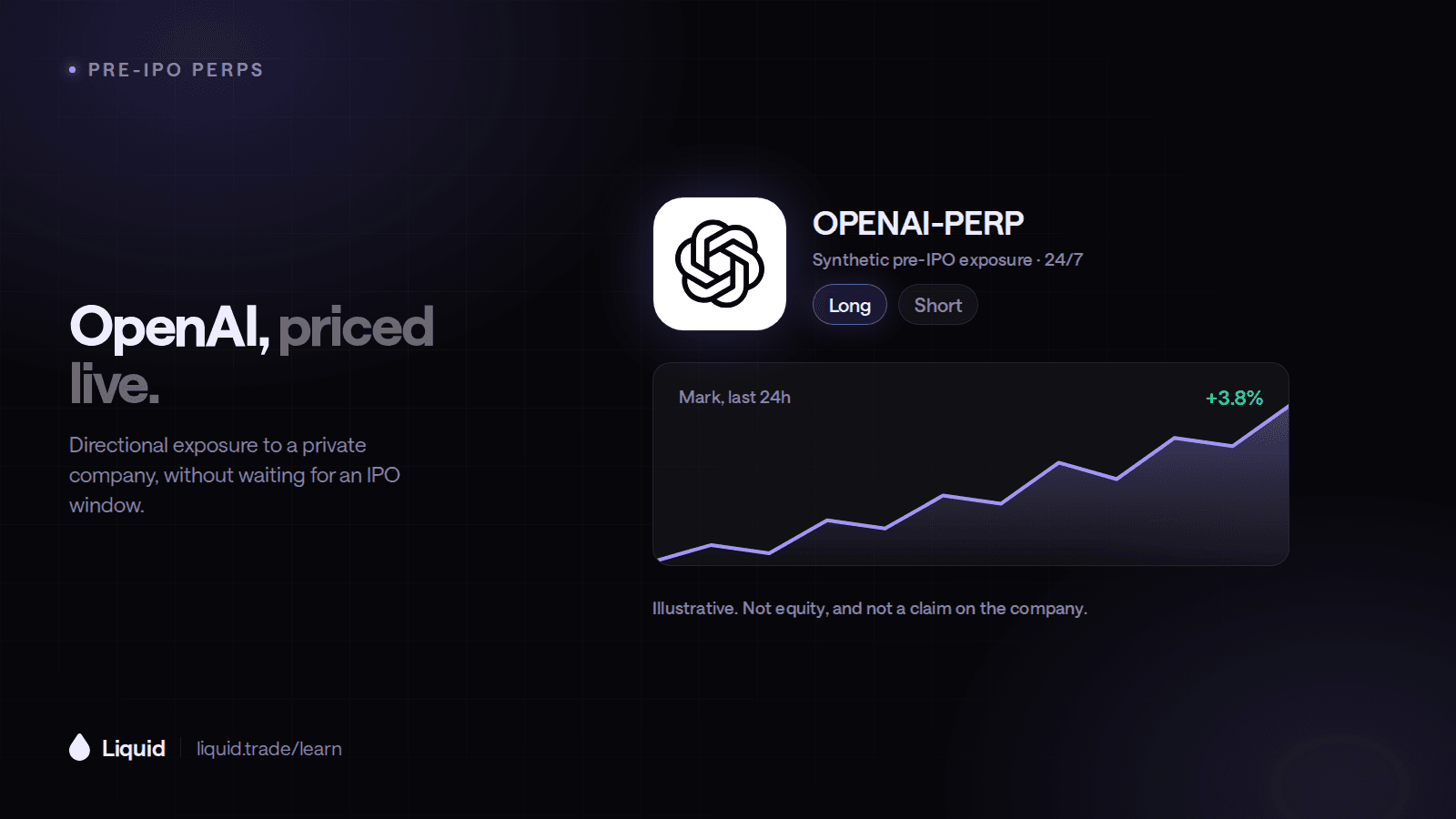
How to Get OpenAI Exposure Before an IPO
Explore OpenAI exposure through Liquid’s OAI perpetual, including long and short positions, reference pricing, and how it differs from private shares.
Put what you learned to work.
Trade crypto, stocks, commodities, FX, indices, and pre-IPO names — plus prediction markets. Prediction contracts are unleveraged; eligible perpetual markets offer multipliers of up to 50×.