
24/7 Trading
Where Can I Trade Gold and Oil at Night?
Explore overnight gold and oil trading through commodity perpetuals, exchange-listed futures, and funds, with a practical guide to hours, sizing, and costs.

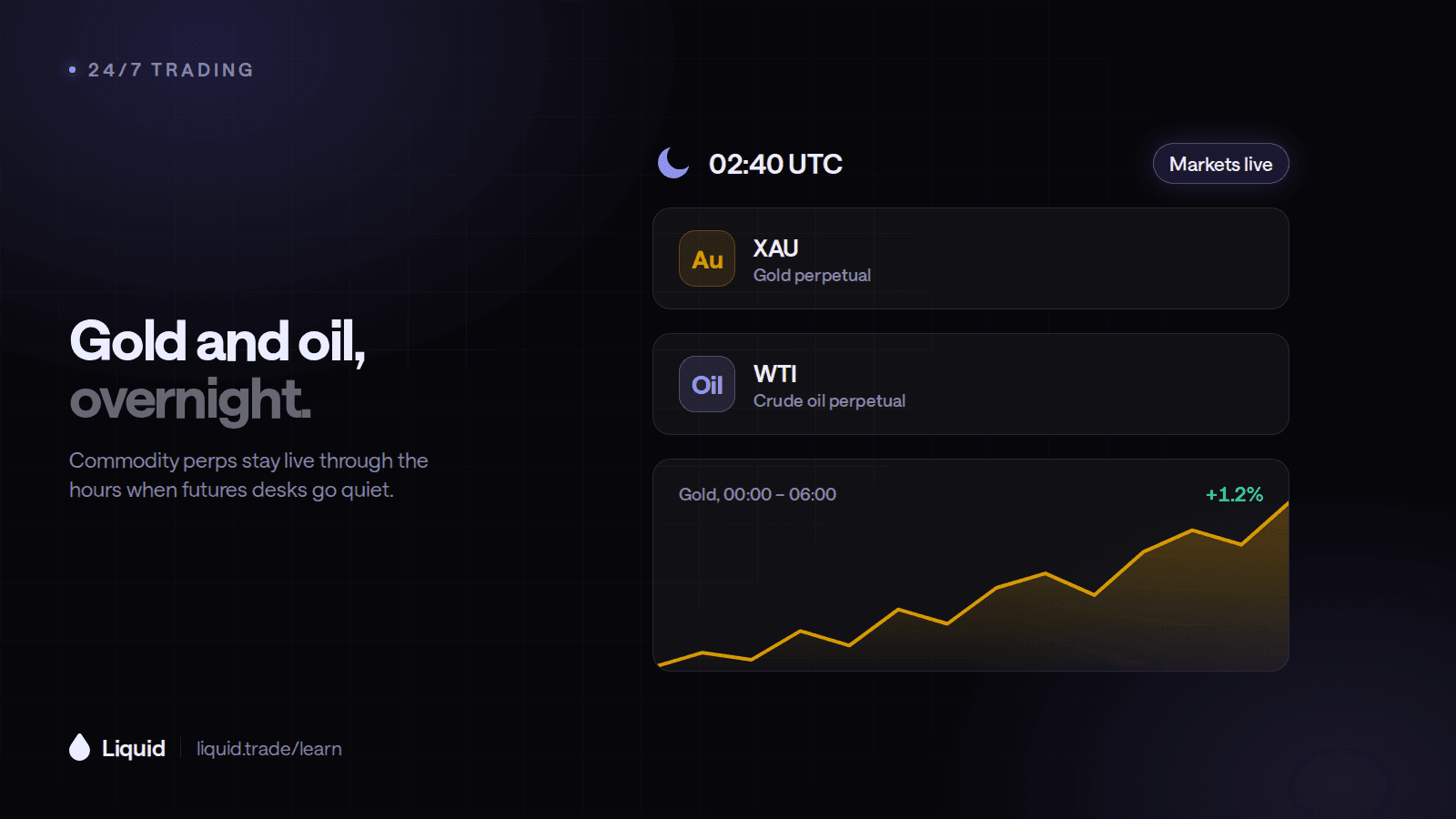
You can trade gold and oil at night through Liquid's 24/7 commodity perpetual markets, or through a broker that offers an active commodity futures session. The exact contract matters: gold, WTI oil, an oil fund, and an energy company's stock are different exposures with different schedules.
Liquid's gold and oil perpetual markets trade through nights, weekends, and holidays. A commodity perp gives long or short price exposure; it does not give you ownership of bullion or barrels. Liquidity, spreads, and execution can vary. Check the current market overview and the live order ticket.
Where can I trade gold and oil at night?
There are three routes to evaluate. Commodity perpetuals on Liquid offer 24/7 exposure, including when traditional exchanges are closed. Exchange-listed futures trade through futures brokers and have exchange-defined contract terms. Commodity funds trade as securities under the sessions supported by the fund's venue and your broker.
For gold futures, CME's benchmark Gold contract offers nearly 24-hour electronic access. Its separate 1-Ounce Gold contract is documented as trading 24/7, subject to maintenance windows. Each has its own contract specifications and schedule. See CME Gold and the 1-Ounce Gold FAQ.
For oil futures, start with the exact WTI contract your broker carries and review its current exchange calendar. CME's materials include multiple WTI contract sizes and an expansion toward seven-day trading; verify the product's actual live status and broker access rather than assuming every oil contract has identical hours. See CME's WTI product information and trading-hours calendar.
Three ways to express a commodity view
Scroll horizontally to compare
| Feature | Commodity perp | Exchange-listed future | Commodity fund |
|---|---|---|---|
| Exposure | Contract tied to a reference price | Standardized commodity contract | Shares in a fund with its own strategy |
| Expiry | No fixed expiry | Specified contract expiry | No futures-style expiry for the share |
| Overnight access | 24/7 on Liquid, including weekends | Contract and broker dependent | Security and broker session dependent |
| Check first | Reference, funding, and margin | Size, settlement, and expiry | Holdings, tracking, and expenses |
Is nighttime trading the same as weekend trading?
Not necessarily. A brokerage instrument can trade through most weekday nights and still pause for maintenance, holidays, or part of the weekend. Liquid's commodity perps support both nighttime and weekend trading. When comparing other products, verify the specific contract's schedule rather than inferring weekend access from the word “overnight.”
For example, CME specifies a Saturday maintenance window and brief weekday maintenance for 1-Ounce Gold futures. The contract schedule and current service notices give you the details needed to plan a session around those windows.
Include the venue's time zone in your plan. A window quoted in US Central Time changes its relationship to some overseas clocks around daylight-saving transitions. Convert the date as well as the hour when checking a late-night session.
What price does the contract actually follow?
For a gold perp, find the stated underlying reference and how the venue constructs its price. For oil, distinguish WTI from Brent and identify whether the reference involves a particular futures contract or another benchmark. Two charts labeled “oil” can move differently because they represent different things.
If you are hedging an existing holding, identify what drives its value. An oil-producer share reflects both the company and the commodity, while a gold fund follows its stated investment strategy. Compare that exposure with the contract's reference before choosing a hedge size.
Imagine a hypothetical $2,000 gold perp position. A 1% movement corresponds to roughly $20 of price profit or loss before costs for a linear dollar-quoted exposure. If you assign $200 of collateral, the position still represents $2,000 of market exposure. Record both the notional and margin, then include fees and funding when evaluating the result.
How do I plan the size and costs of an overnight trade?
Start with the spread and depth for your intended order. Compare the expected fill with the displayed quote, then add fees and the cost of holding the position. Perpetual funding payments can be paid or received and may change over time. Listed futures instead require attention to expiry, settlement, and the cost of changing contracts if you continue the exposure.
On Liquid, start with the total exposure you want and review the corresponding margin. Choose whether you want a long or short position, then set the target or event that would complete the trade. The stop-loss guide explains the exit tools you can use as part of that plan.
How to start on Liquid
Search for the specific gold or oil market, confirm that it is available to your account and jurisdiction, and read its contract details. Review direction, notional size, margin, costs, and exit orders before confirming. After submission, check the filled quantity and use the position view to track the trade.
For a first session, choose one commodity you already follow and write down the reason for the trade. Keep the reference chart, your expected holding period, and the next scheduled event together. Paper trading lets you practice that sequence with simulated funds before preparing a live order.
If your purpose is protection rather than a new directional position, the guides to hedging gold and hedging oil explain the separate sizing and tracking questions.
Explore commodity markets on Liquid →
Sources and further reading
- Liquid: commodity markets and availability
- CME Group: Gold futures
- CME Group: 1-Ounce Gold futures FAQ
- CME Group: trading hours and holidays
- Liquid documentation: funding rates
Product information checked September 18, 2026. Use current contract specifications and the live market for trading-hour decisions.
Educational content only — not investment advice. Trading perpetual futures involves substantial risk and may not be suitable for every investor. Past performance is not indicative of future results.
Keep reading
All articles →
24/7 Trading
How to Choose the Best Platform for Around-the-Clock Trading
Choose an around-the-clock trading platform by its markets, trading hours, costs, and practical tools for researching, opening, and managing positions.
24/7 Trading
Which Platforms Let Me Trade on Weekends? A Sunday Trading Guide
Explore Saturday and Sunday trading on Liquid, choose the market for your idea, and follow a practical workflow from research to a reviewed order.
24/7 Trading
Where Can I Trade Stocks 24/7? Shares, Overnight Sessions, and Stock Perps
Find out when you can trade actual shares, how overnight brokerage sessions work, and where stock perpetuals fit when exchanges are closed.
Put what you learned to work.
Trade crypto, stocks, commodities, FX and pre-IPO names — with multipliers of up to 50×, depending on the market, and instant settlement.