
24/7 Trading
How to Choose the Best Platform for Around-the-Clock Trading
Choose an around-the-clock trading platform by its markets, trading hours, costs, and practical tools for researching, opening, and managing positions.

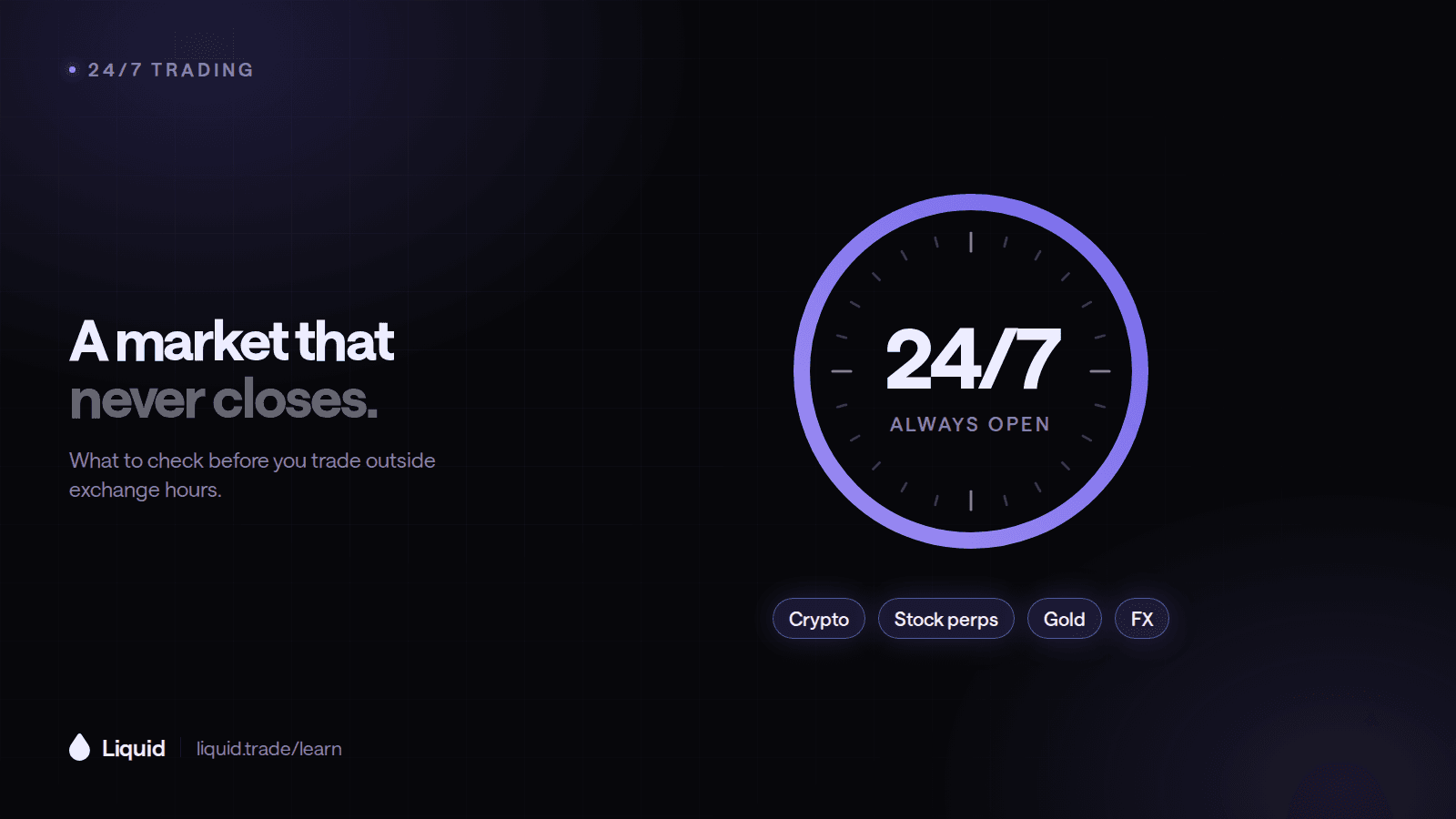
The best platform for around-the-clock trading is the one that offers your intended instrument, at your intended time, under terms you understand. For 24/7 perpetual exposure across stocks, commodities, currencies, and crypto, consider Liquid. For share ownership, compare brokerage account features and supported sessions. For exchange-listed futures, check access to the exact contract and session you need.
Start with the kind of exposure you want. Buying a stock, buying a coin, and opening a perpetual contract serve different purposes. Once that choice is clear, compare the features you will use from research through closing the position.
What is the best platform for around the clock trading?
Liquid is worth evaluating if you want long or short perpetual exposure across its listed markets in one interface, 24/7. Its documentation describes market and limit orders, stop-loss and take-profit tools, and paper trading. Verify the live market's execution conditions, available controls, and jurisdictional eligibility before deciding it meets your needs.
If your goal is to accumulate actual shares, review a securities account's ownership rights, eligible symbols, and supported sessions. If you need a listed futures contract with a particular expiry or settlement method, compare the account's permissions with exchange specifications. For a perpetual, review the price reference, margin settings, and funding terms.
Use these product categories to build your own shortlist. The most useful choice will reflect your preferred markets, account eligibility, order size, and trading schedule.
Match the platform to the job
Scroll horizontally to compare
| Your goal | Start with | Verify before opening a trade |
|---|---|---|
| Own shares outside core hours | A broker with overnight share trading | Eligible symbols, session, order types, and fees |
| Trade crypto perps through the weekend | A perpetual platform such as Liquid | Market access, collateral, funding, and execution |
| Trade a stock or commodity perp 24/7 | Liquid's listed perpetual markets | Reference price, contract terms, and liquidity |
| Trade exchange-listed futures | A broker carrying the intended exchange product | Contract size, expiry, margin, and maintenance |
Which brokers offer 24/7 trading?
The answer depends on the product, so separate a perpetual trading platform from a brokerage account for shares or exchange-listed futures. Liquid offers 24/7 trading across its listed perpetual markets, including nights, weekends, and holidays. Its contracts provide price exposure rather than ownership of the underlying share, and liquidity and execution still vary by market. See Liquid's market overview.
For a securities broker, verify the exact stock, session, and order type you intend to use. Extended and overnight schedules differ from seven-day trading. FINRA explains that firms set their own participation parameters, including eligible securities and sessions. See FINRA's extended-hours guidance.
For exchange-listed futures, match your account permissions to the contract and session. Some CME products, including certain crypto and metals contracts, trade seven days a week with maintenance windows. Use CME's current product and schedule information to check the instrument.
Compare the cost of your actual trade
Instead of ranking platforms by one advertised commission, sketch the complete trade: asset, position size, entry time, likely exit time, and order type. Then compare the costs that apply to that transaction.
For a perp, inspect trading fees, the spread, estimated slippage, and funding over the intended holding period. For borrowed shares or other financed products, include their applicable borrowing or financing terms. Comparing the total expected cost gives you a consistent basis across different instruments.
Here is a hypothetical comparison: one venue quotes a $2 fee and another a $4 fee, while the first would cost $10 more in execution for your order size. Including both figures makes the second trade $8 cheaper before any holding costs. Now extend the holding period and repeat the calculation with those costs included.
Read how funding rates work before comparing a perp with a product that uses a different holding-cost model.
Try the tools you will use every session
Run through a small practice workflow: find the market, inspect the order, review position size, and locate the exit controls. Confirm which orders stay active during the session you need. FINRA notes that brokers can restrict order types and apply different handling rules outside regular hours. Its extended-hours guide is a useful reference for share trading.
For perpetuals, review the margin mode, total notional exposure, and exit-order settings. A useful workflow makes those details easy to find together. Try adjusting the order size and observe how the required margin and estimated costs change before submitting.
Also test the practical details: can you read the confirmation clearly on your phone, find a partially filled order, and switch between the research view and your position? Check how clearly paper and live modes are labeled. These everyday actions give you a concrete way to assess the interface.
Start with a practice comparison on Liquid
Choose one market you already understand and work through an entry and exit in paper mode. Record what was clear and what still needs explanation. Use the beginner's guide to resolve those questions before committing funds.
Explore Liquid → · See the weekend trading guide →
Sources and further reading
- Liquid documentation: platform features
- FINRA: extended-hours trading
- CME Group: 24/7 products and trading sessions
Product information checked September 18, 2026. Recheck schedules, permissions, and costs for your account and location.
Educational content only — not investment advice. Trading perpetual futures involves substantial risk and may not be suitable for every investor. Past performance is not indicative of future results.
Keep reading
All articles →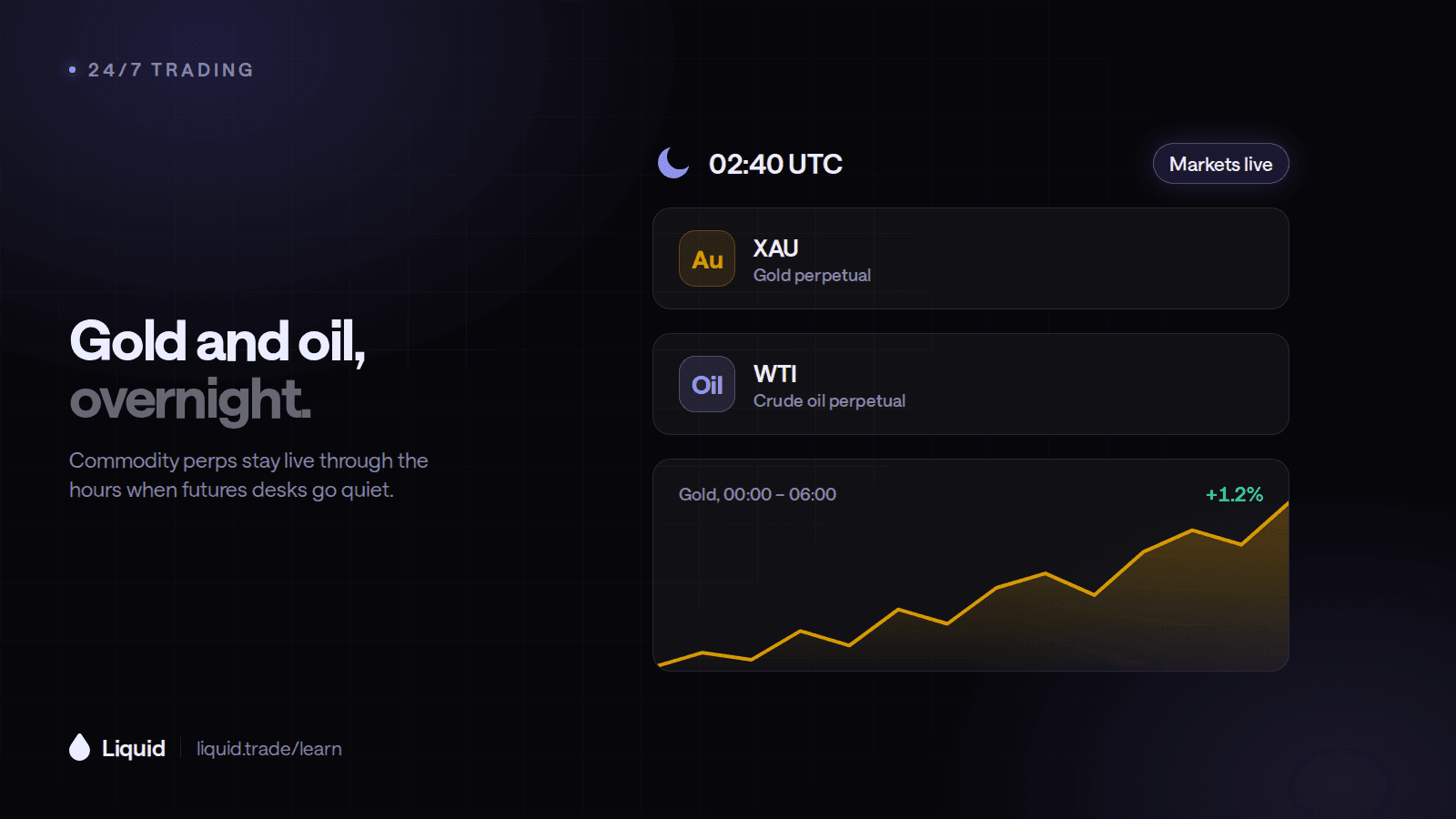
24/7 Trading
Where Can I Trade Gold and Oil at Night?
Explore overnight gold and oil trading through commodity perpetuals, exchange-listed futures, and funds, with a practical guide to hours, sizing, and costs.
24/7 Trading
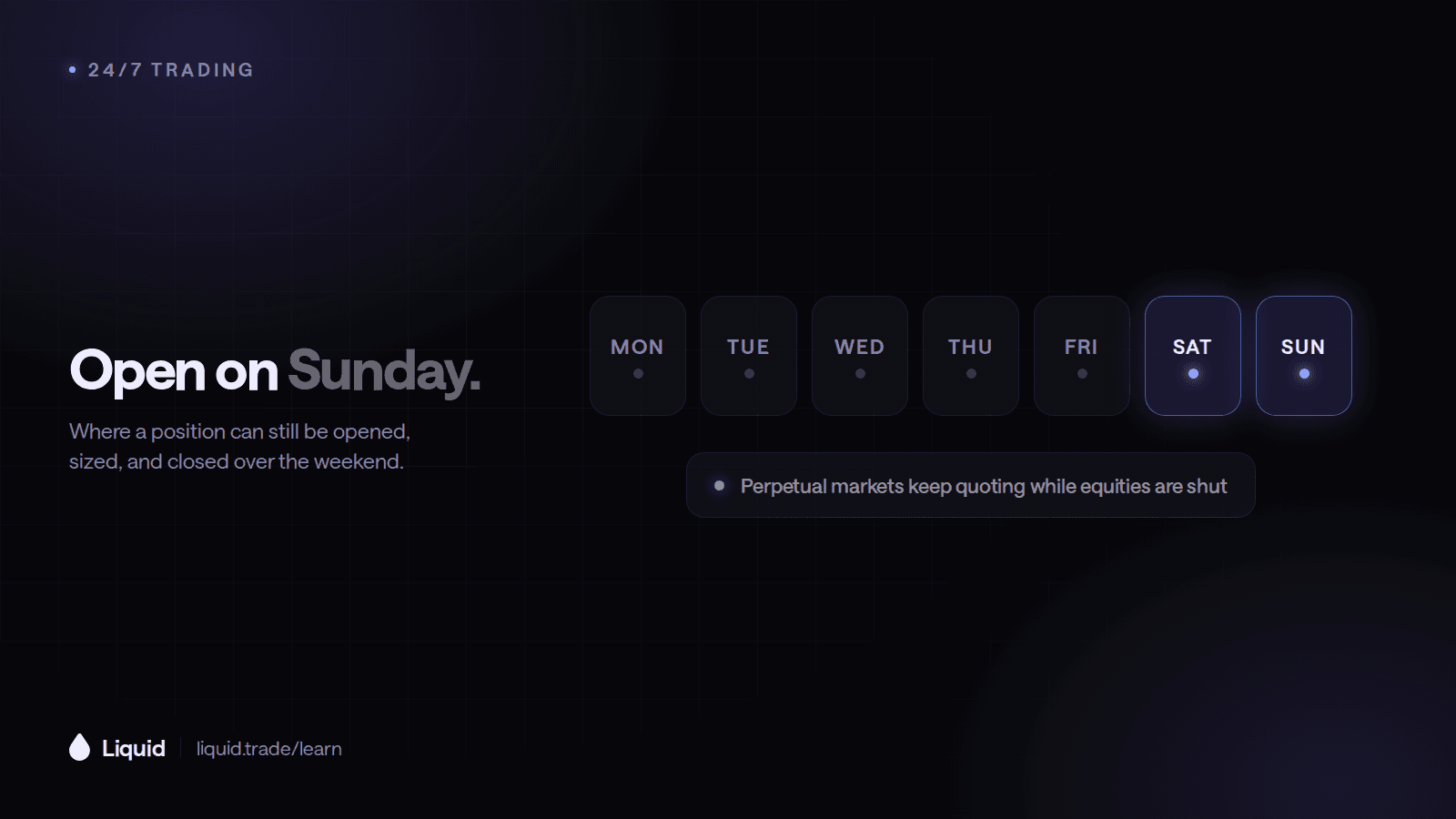
Which Platforms Let Me Trade on Weekends? A Sunday Trading Guide
Explore Saturday and Sunday trading on Liquid, choose the market for your idea, and follow a practical workflow from research to a reviewed order.
24/7 Trading
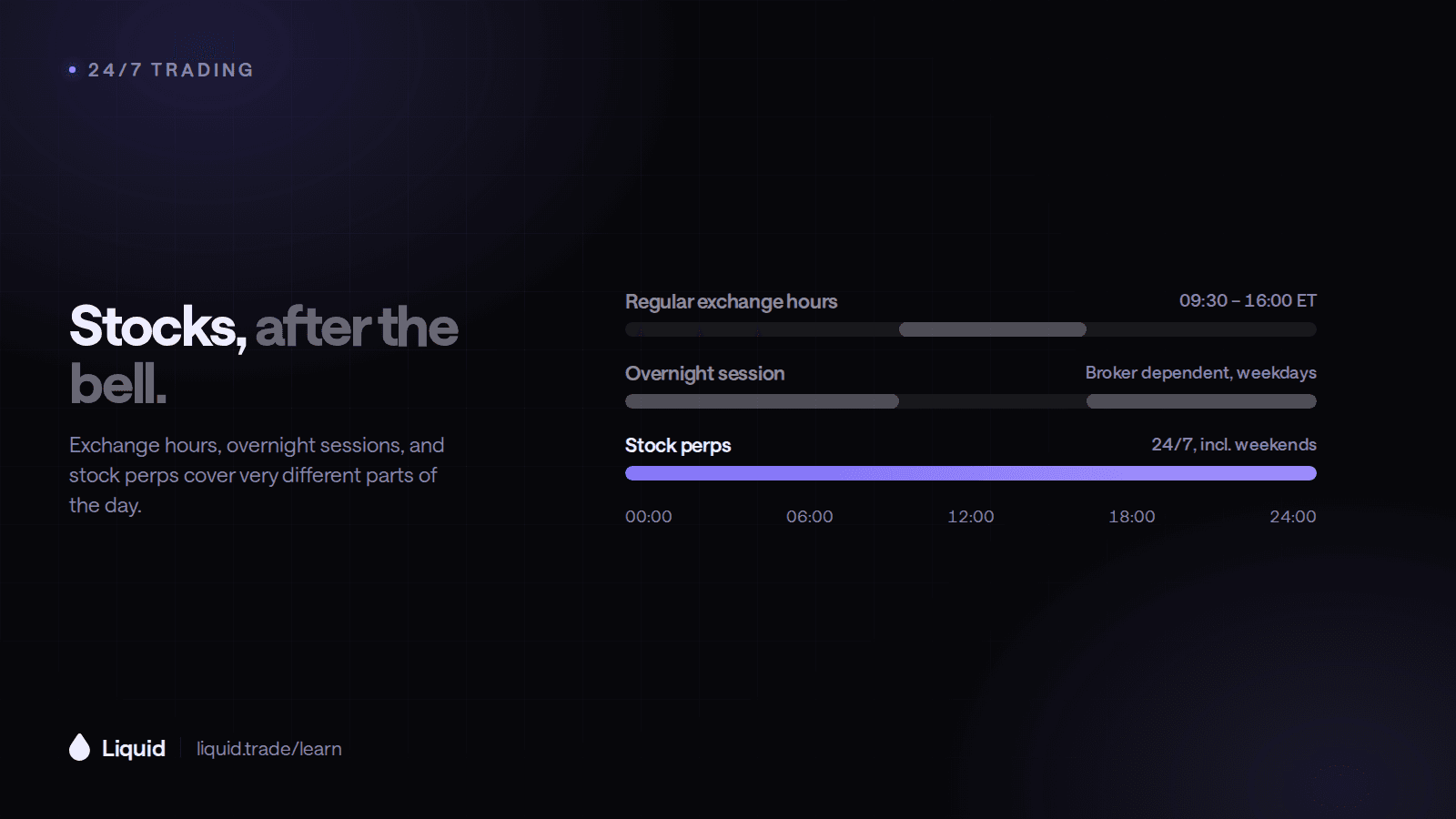
Where Can I Trade Stocks 24/7? Shares, Overnight Sessions, and Stock Perps
Find out when you can trade actual shares, how overnight brokerage sessions work, and where stock perpetuals fit when exchanges are closed.
Put what you learned to work.
Trade crypto, stocks, commodities, FX and pre-IPO names — with multipliers of up to 50×, depending on the market, and instant settlement.