
Education
The Beginner's Guide to Trading (Without the Fear)
Real markets, real mechanics, simulated money. Here's how to learn before you risk anything.

If you've ever watched markets move and thought "I could do that," but stopped because you didn't want to lose your own money figuring it out, this is for you.
There's a way to learn the entire thing first. Real markets, real prices, real mechanics. Zero risk. It's called paper trading, and it's how a lot of traders (including people on our own team) got started without the fear of blowing up their savings on day one.
Here's what it is, what trading on Liquid actually involves, and why practicing first is the smartest way to begin.
First, what is day trading?
Day trading just means buying and selling assets over short time horizons — sometimes minutes, sometimes hours — to try to profit from price moves, rather than buying something and holding it for years.
Traders do this across all kinds of markets: crypto like Bitcoin and Ethereum, stocks like Tesla and Nvidia, commodities like gold and oil, and currencies. The goal is the same everywhere: read where the price might go, take a position, and manage your risk along the way.
It looks simple from the outside. The reality is that there's a lot to learn (e.g., order types, leverage, when to cut a loss, how fees work) and most of that vocabulary is genuinely confusing the first time you see it. That learning curve is exactly why so many people never start.
What Liquid does
Liquid is a trading platform where you can trade crypto, stocks, indices, commodities, FX, and pre-IPO company exposure such as OpenAI and Anthropic, plus prediction markets on real-world events. Crypto perpetuals are generally available 24/7; hours and availability for other markets vary by market and underlying venue, so check the live market status before trading.
Many markets on Liquid are perpetual futures ("perps" for short). Don't let the name scare you. A perpetual future is just a contract that tracks the price of something and lets you bet on it going up or down, without an expiry date. If you think the price will rise, you go "long." If you think it'll fall, you go "short." You don't have to own the underlying asset to trade it. Prediction markets are separate unleveraged event contracts, so their order and settlement mechanics differ.
Eligible perps can also let you use leverage, which means controlling a larger position with a smaller amount of money. Leverage can amplify gains and just as easily amplify losses. It's powerful, and it's exactly the kind of thing you want to understand before real money is on the line.
Which brings us to the point.
The smart way to start: practice first
Here's the problem with most people's first trade: they're learning the platform, learning the vocabulary, and risking real money all at the same time. That's three hard things at once, which can feel overwhelming.
Paper trading removes the scariest one. You get a balance of simulated money and you trade with it on live, real-time markets. Every price is real. Every order behaves the way it would with real funds. The only thing that's simulated is the money, so when you make a mistake (everyone does at first), it costs you nothing but a lesson.
Some practice with this will cause things that looked like a foreign language start to click:
- You'll see what happens when a leveraged position moves against you, instead of just reading a warning about it.
- You'll learn what a stop loss actually does by setting one and watching it work.
- You'll get a feel for how fast markets move, how fees eat into a trade, and what "getting liquidated" really means without the gut-punch of it happening to your savings.
By the time you fund a real account, none of it is new. You've already done it. The only thing that changes is that the wins and losses become yours.
That's the whole idea: practice should feel exactly like the real thing, so the real thing feels easy.
Turning it on takes about ten seconds. In the Liquid app, open Settings, go to the Trading tab, scroll down to Paper trading mode and flick the switch. A PAPER TRADING ACTIVE banner appears across the top and your balance becomes $10,000 of simulated funds. From there the first trade is just a size and a button: type an amount, hit buy, and the position shows up in the table underneath the chart with its entry price, its margin and the price that would liquidate it — the same numbers you'd be reading with real money behind them.
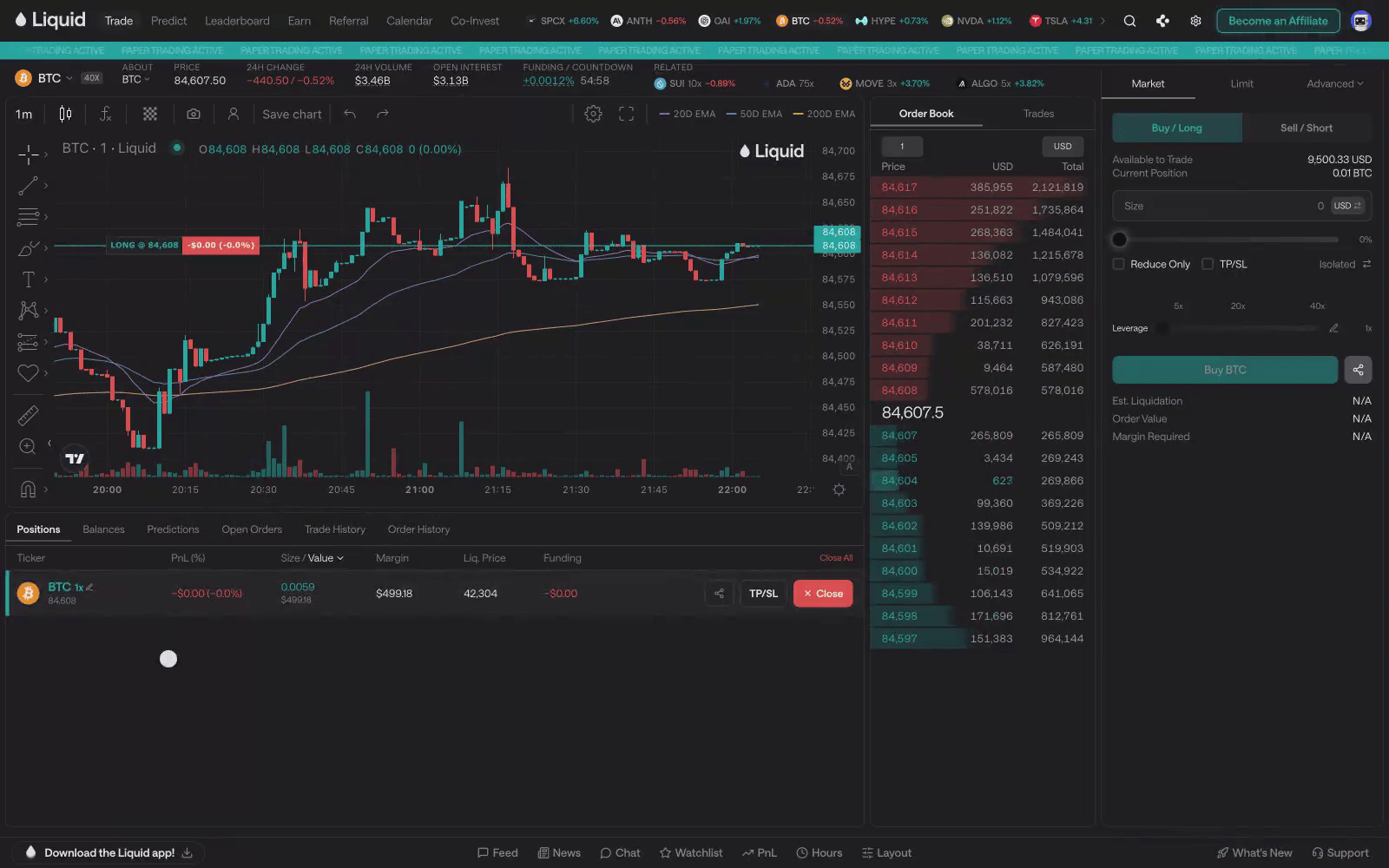
Paper mode covers crypto perpetuals, the stock, index, commodity and FX perps that run on Liquid's own markets, and prediction markets — so you can practice event contracts as well as leveraged trades. A few things aren't simulated yet: crypto spot, and markets routed through external venues like Ostium, Lighter and Kalshi. If you open one, the app steers you back to a supported market. The full walkthrough is in How to start paper trading on Liquid.
You don't even have to do it alone
One more thing worth knowing. Liquid connects to AI assistants like Claude, ChatGPT, Grok, and Meta Muse through a feature called Co-Invest, so you can literally ask an AI to walk you through a trade, explain what a term means, or talk through a strategy while you practice.
For a beginner, that's like having a patient tutor sitting next to you the entire time. Ask "what's a funding rate?" or "should I use leverage here?" and get a real answer in plain language, right when you need it. Paired with paper trading, it turns the scariest part of starting — not knowing what you don't know — into something you can just ask about.
How to start
From your first simulated trade to a real account
Open Liquid Co-Invest
Tell your AI to turn on "paper trading" mode. You'll get a balance of simulated funds to trade with.Make your first practice trade
Pick something you actually follow — a coin, a stock, whatever you find interesting. Go long or short. Watch what happens.Use the guides and the AI
When a term trips you up, look it up in our Learn section or just ask Claude, ChatGPT, Grok, or Meta Muse through Co-Invest.Graduate when you're ready
When the mechanics feel second nature and you've found your footing, funding a real account is a small, confident step.
The fear of losing money before you understand what you're doing is real, and it stops a lot of good would-be traders before they begin. Paper trading is how you get past it. Learn the whole landscape, build real confidence, and trade for real — just not with real money. Yet.
Start practicing free → · Try Co-Invest →
Ready to add real funds? Follow our on-ramping tutorial for card, bank, and crypto deposits, including how to check fees, match networks, and confirm your balance.
Frequently Asked Questions
What is day trading?
Day trading means buying and selling over short horizons — minutes or hours — to profit from price moves, rather than holding an asset for years. Traders do it across crypto, stocks, commodities, and currencies, and the job is the same everywhere: read where price might go, take a position, and manage risk.
What is paper trading and how do I try it?
Paper trading gives you a balance of simulated money to trade on live, real-time markets. Every price and order behaves as it would with real funds, so mistakes cost you nothing but a lesson. On Liquid you can turn on paper trading through Co-Invest and place your first practice trade in minutes.
Can I learn to trade without risking real money?
Yes. Learning the platform, the vocabulary, and risking real capital all at once is three hard things at the same time. Paper trading removes the riskiest one, so by the time you fund a real account the mechanics are already familiar.
What can I trade on Liquid as a beginner?
Liquid offers crypto, stocks, indices, commodities, FX, and pre-IPO company exposure, plus prediction markets. Crypto perpetuals trade 24/7; hours and availability for other markets vary by market and venue. Eligible perpetuals support long/short exposure and leverage, while prediction markets are separate unleveraged event contracts.
Can an AI assistant teach me while I practice trading?
Yes. Co-Invest connects Liquid to Claude, ChatGPT, Grok, and Meta Muse, so you can ask what a term means, talk through a strategy, or have the AI walk you through a trade while you practice — for example, "what is a funding rate?" answered in plain language, right when you need it.
Educational content only — not investment advice. Trading perpetual futures involves substantial risk and may not be suitable for every investor. Past performance is not indicative of future results.
Keep reading
All articles →
Education
How to Start Paper Trading on Liquid
Trade real markets with simulated funds. Learn how to turn on paper trading mode, which markets it covers, how to reset your practice balance, and where its limits are.
Education
How to Trade on Liquid
Place and manage your first trade on Liquid. Learn how to choose a market, read size and margin, set exit orders, confirm a fill, and close a position.
Education
How to Fund Your Liquid Account
A step-by-step on-ramping tutorial: add money with a card or bank transfer, move crypto from another app or wallet, and check when your funds are ready.
Put what you learned to work.
Trade crypto, stocks, commodities, FX, indices, and pre-IPO names — plus prediction markets. Prediction contracts are unleveraged; eligible perpetual markets offer multipliers of up to 50×.