
Education
What Every Market on Liquid Actually Is
New to Liquid? A beginner's guide to crypto, stock, index, commodity, FX, pre-IPO, and prediction markets — and what actually moves each one.

A perpetual future ("perp") lets you trade the price of an asset without ever owning it and without an expiry date. You go long if you think the price rises, short if you think it falls, and you can use leverage to size up.
The perpetual markets on Liquid share the same basic mechanics: pick a side, set your size and leverage, place the order. But what drives the price, and what you should actually be watching, changes a lot depending on what you're trading. Prediction markets work differently, so they get their own section below. Here's a beginner's guide to each market type.
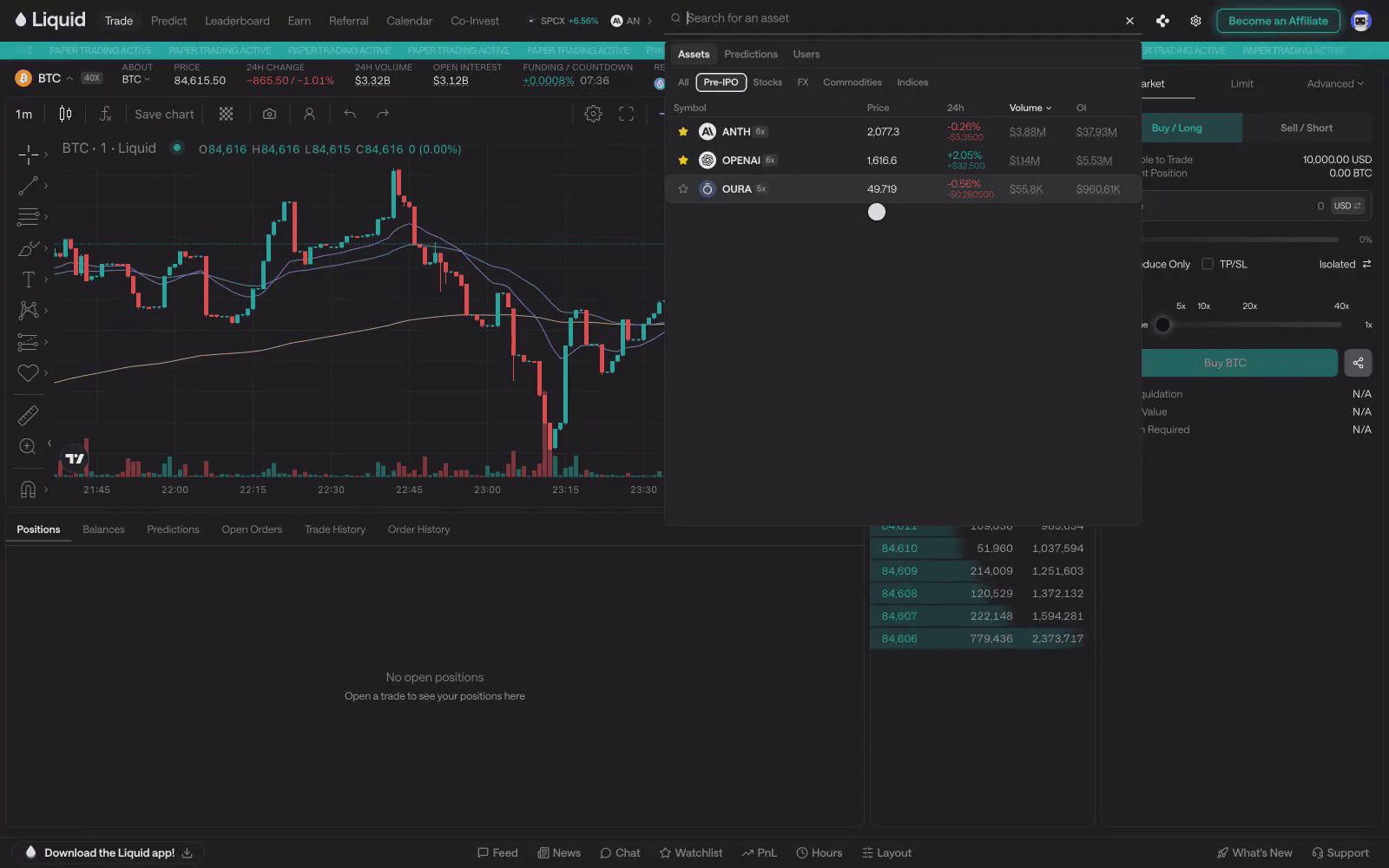
All of them live in one list. Open the market selector from any chart and crypto, oil, SpaceX, gold, Nvidia, Tesla, Anthropic, EUR/USD and OpenAI are rows in the same table — each with its own maximum leverage, which is the first thing worth noticing: the number is set per market, not per account.
The one thing that's the same across perps: funding
Before the differences, the shared piece. Because a perp never expires, there has to be something pulling its price back in line with the real price of the underlying asset. That's the funding rate. If more traders are long, longs pay shorts. Holding a long costs you a little over time. If more traders are short, shorts pay longs.
You don't do anything to make this happen — it's automatic. Just know that holding a position for a long time has a small running cost (or credit) and that's funding. It matters more the longer you hold.
Crypto perps
A crypto perp tracks the price of a coin like Bitcoin without you ever holding the coin itself.
What moves the price: Crypto trades 24/7 and reacts to everything — macro news, big liquidations, social sentiment, ETF flows, whatever Bitcoin is doing that day. It's the most volatile category here.
What's different for beginners is that the market never closes, so a position can move overnight. Volatility is high, which means leverage cuts both ways faster than anywhere else. A small move against you at high leverage can liquidate you.
Stock (equity) perps
A stock perp lets you trade the price of a company's shares without buying the actual stock. You're betting on which way the share price moves, with leverage if you want it. Depending on the market and underlying venue, a stock perp may be available outside the stock's regular exchange session; check the live market status before relying on overnight or weekend access.
What moves the price: Company-specific news such as earnings, product launches, and analyst upgrades, as well as the broader stock market mood.
The regular U.S. stock-market session runs roughly from 9:30am–4:00pm ET on weekdays. Big news often hits outside those hours, so the underlying shares can gap when the regular session reopens.
Index perps
An index perp tracks a benchmark such as the S&P 500 or Nasdaq 100 rather than one company. It gives you one position on a basket of stocks without owning the constituent shares.
What moves the price: Broad equity sentiment, interest-rate expectations, macro data, and moves in the largest companies inside the index. Because an index spreads exposure across many companies, a single earnings report usually matters less than it does for a stock perp, while market-wide news matters more.
Commodity perps
A commodity perp lets you trade the price of something like gold or oil without ever touching the physical thing. You're trading the price purely as a number, long or short, with leverage.
What moves the price: Big-picture forces such as supply and demand, geopolitics, the strength of the US dollar, and inflation expectations. Oil reacts to OPEC decisions and conflicts; gold tends to rise when people are nervous and seeking safety.
This is usually a "macro" trade, meaning that you're betting on a theme rather than a single company's news. Gold in particular often moves opposite to risk assets like stocks and crypto. When markets panic, gold frequently catches a bid.
These are good for expressing a view on the world rather than reacting to a single headline.
FX perps
An FX perp lets you trade the exchange rate between two currencies, and crucially, you're trading as a pair. EUR/USD isn't "the euro," it's the euro versus the dollar. Going long EUR/USD means you're betting the euro strengthens against the dollar; going short means the opposite. You never hold actual currency; you're just trading which way the rate moves.
If you want to trade against the US dollar specifically, pair direction matters: go long EUR/USD or GBP/USD, or short USD/JPY. See the full leveraged USD guide.
What moves it: Interest rates and central bank policy, above all. A currency pair is a bet on one country's economy relative to another's.
Individual moves are usually small in percentage terms compared to crypto, which is why FX is often traded with higher leverage. That also means liquidation can come from what looks like a tiny move. In addition, central bank meetings (the Fed, ECB, Bank of Japan) are the big scheduled events. It is important to know that FX is heavily driven by scheduled data releases like job reports and rate decisions, and the price can jump hard the second those numbers come out.
Pre-IPO perps
A pre-IPO perp gives you directional exposure to the reference valuation of a private company such as OpenAI or Anthropic without buying private shares or receiving ownership rights. You're trading a perpetual contract tied to a reference price, not stock in the company.
What moves the price: Private-market transactions and valuation updates, fundraising news, company milestones, and expectations around a future public listing. These markets can be less liquid than major crypto or public-equity markets, so spreads and execution can vary more.
Predictions
This one works differently from everything above. A prediction market isn't tracking a continuous asset price — it's tracking the probability of an event (e.g., an election outcome or a sports result).
The price represents an implied probability, usually shown between 0 and 1. A price of 0.65 means the market thinks there's roughly a 65% chance the event happens. These resolve to a fixed outcome, so at the end, the event either happened or didn't and the market settles accordingly. That's very different from a stock or crypto perp, which just keeps trading. Also, there's no leverage on predictions. You're buying a probability, not a leveraged price exposure.
Think in terms of "is the market's probability wrong?" rather than "is the price going up?" If you believe an event is more likely than the current price implies, that's your edge.
The bottom line
Liquid's perpetual markets share the same basic long/short mechanics, while prediction markets use event contracts instead. What changes across the perpetual markets is what you're watching: a Fed meeting for FX, an earnings date for stocks, broad risk sentiment for indices, a private-market valuation update for pre-IPO names, or OPEC for oil. For predictions, the question is whether the market's implied probability is wrong.
The best way to get a feel for how each market behaves without risking anything? Paper trade it. You can practice on live prices with simulated money, see how each market moves, and build intuition before putting real capital on the line.
Frequently Asked Questions
What markets can I trade on Liquid?
Liquid offers crypto, stock (equity), commodity, and FX perpetual futures, plus prediction markets on real-world events. The order ticket is the same across all of them — what changes is what drives the price.
Do all Liquid markets pay funding?
Every perpetual market does. Because a perp never expires, the funding rate pulls its price back toward the underlying: when more traders are long, longs pay shorts, and when more are short, shorts pay longs. It is automatic, and it matters more the longer you hold.
How are stock perps different from crypto perps?
Crypto trades 24/7 and reacts to macro news, liquidations, and sentiment, making it the most volatile category. Stock perps track a company’s share price and can be traded even when the underlying market is closed, but the shares themselves trade roughly 9:30am–4:00pm ET, so prices can gap when news lands outside those hours.
What moves commodity and FX perps?
Commodities move on supply and demand, geopolitics, the strength of the US dollar, and inflation expectations — oil on OPEC decisions and conflict, gold often up when markets get nervous. FX is driven above all by interest rates and central bank policy, with scheduled releases such as rate decisions and jobs reports causing sharp jumps.
How do prediction markets differ from perps?
A prediction market tracks the probability of an event rather than a continuous asset price. Prices sit between 0 and 1, so 0.65 implies roughly a 65% chance, and the market settles once the event resolves. There is no leverage: you are buying a probability, not leveraged price exposure.
Educational content only — not investment advice. Trading perpetual futures involves substantial risk and may not be suitable for every investor. Past performance is not indicative of future results.
Keep reading
All articles →
Education
How to Start Paper Trading on Liquid
Trade real markets with simulated funds. Learn how to turn on paper trading mode, which markets it covers, how to reset your practice balance, and where its limits are.

Education
How to Trade on Liquid
Place and manage your first trade on Liquid. Learn how to choose a market, read size and margin, set exit orders, confirm a fill, and close a position.
Education
How to Fund Your Liquid Account
A step-by-step on-ramping tutorial: add money with a card or bank transfer, move crypto from another app or wallet, and check when your funds are ready.
Put what you learned to work.
Trade crypto, stocks, commodities, FX, indices, and pre-IPO names — plus prediction markets. Prediction contracts are unleveraged; eligible perpetual markets offer multipliers of up to 50×.