
AI & Trading
The Best AI Tools for Market Research and Trading: How to Choose
Compare AI research assistants, account-aware trading tools, backtesting platforms, and autonomous agents by what they actually do.

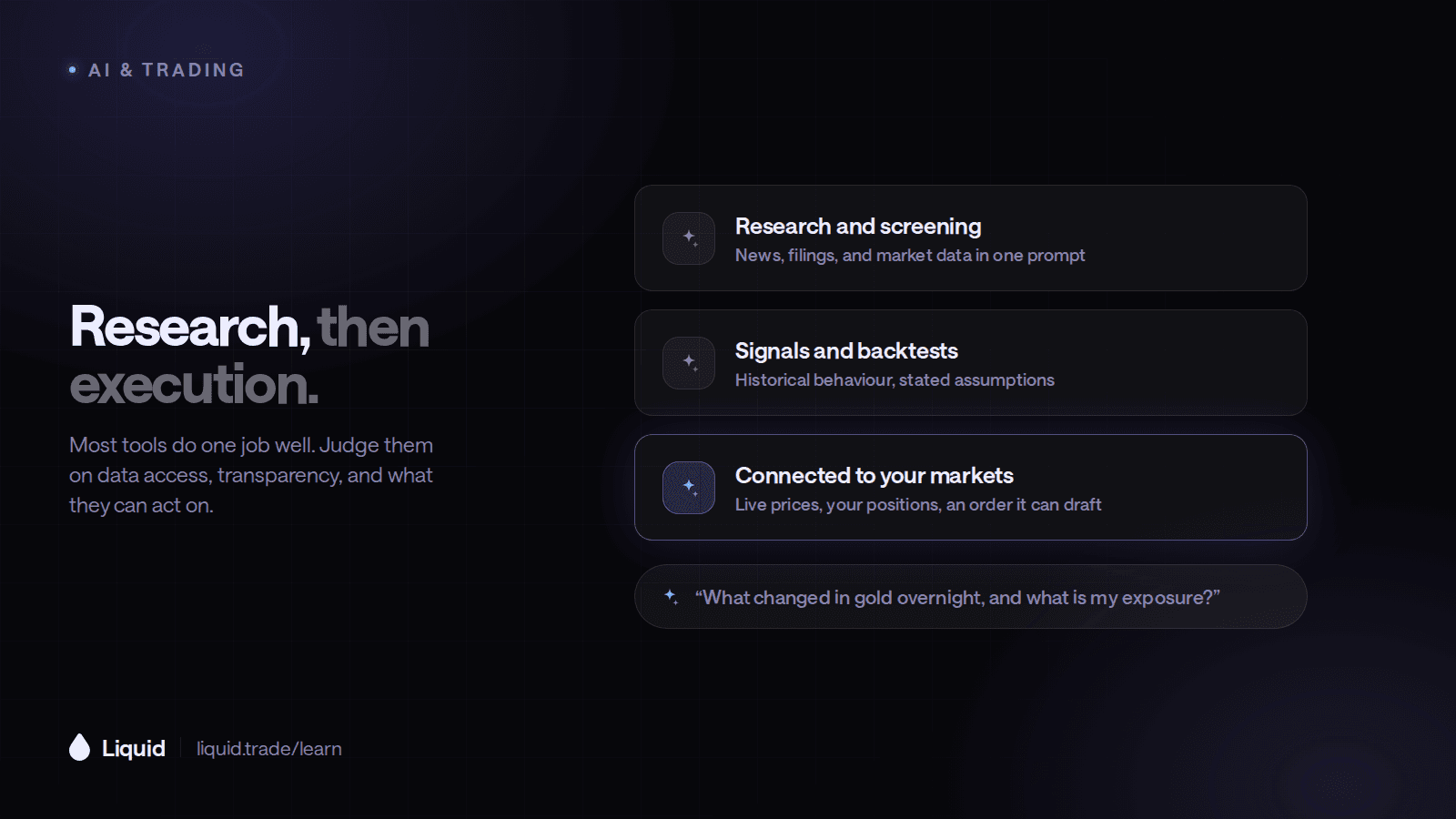
The best AI tools for market research and trading depend on the job: understanding a market, reviewing your account, testing a strategy, or executing it. Liquid Co-Invest is an option for account-aware market research and trade proposals. Historical backtesting tools serve a different purpose: checking how a coded strategy would have behaved on past data.
Start with the decision you need help making. For an active trading workflow, current market data, portfolio context, and a clear path to order review make research more actionable.
What Are the Best AI Tools for Market Research and Trading?
A useful shortlist connects each tool to the part of your workflow it can improve.
Choose a tool for a specific job
Scroll horizontally to compare
| Tool or workflow | Useful for | What to verify |
|---|---|---|
| AI assistant with supplied sources | Summarizing reports and exploring a thesis | Source dates, supporting evidence, and context |
| Liquid Co-Invest | Market research informed by your Liquid account | Market coverage, current data, and order review |
| Historical backtesting tools | Testing a coded strategy against historical data | Trading costs, data quality, and out-of-sample results |
| Liquid Co-Invest Computer | Monitoring and executing a defined agent strategy | Execution mode, enforceable limits, and supervision |
For research, ask for evidence that could change your mind. If you supply an earnings release, have the assistant distinguish the company's reported results from its outlook and from the assistant's interpretation. A summary should lead back to the original document, especially when one number drives the trade.
For account context, Co-Invest's documentation describes market analysis, funding, news, positions, open orders, and portfolio planning. Detailed positioning analytics enrich its core crypto coverage, while price action and news support research across other listed markets.
For systematic testing, look for historical backtests that account for trading costs and let you reserve data for a later evaluation. Testing on observations that were not used to develop the strategy gives you a broader view of how its rules behave. Use those results alongside simulation and ongoing evaluation; historical performance does not guarantee live returns.
What Is the Best AI Trading Platform?
The best AI trading platform for your workflow is one that combines the right market access, verifiable inputs, understandable costs, and the level of control you want. Liquid is relevant when you want research connected to a trading account and a path from an idea to a reviewed order.
Compare platforms on these questions:
- What can it observe? Current prices, your actual account, or only information you paste into a chat?
- What can it do? Explain, propose an order, submit an approved order, or execute autonomously?
- How much control do you want? Review each proposal yourself or enable an agent to work within a defined strategy?
- Can you test the workflow? Look for simulation, order previews, and an accessible activity history.
- Can you use the product? Confirm supported markets and account eligibility before comparing features.
Use the answers to build a workflow around your needs. On Liquid, the same market discussion can include your existing positions, the proposed exposure, and the steps needed to review a trade.
What Should an AI Market Research Answer Include?
A useful answer separates observation, interpretation, and proposed action. For example, positive funding is an observable cost for a long perp position. Calling that position crowded is an interpretation that needs additional evidence. Suggesting a short is a further decision that needs its own entry and exit conditions.
Try a prompt such as:
Compare BTC and ETH using current price, funding, recent news, and available positioning. Date the data, link the sources, explain what is missing, and give the strongest case against each thesis. Do not prepare a trade yet.
Follow the source links and identify the original announcement behind a headline. Then connect the event time to the market's response and your intended holding period. Asking “what has changed since yesterday?” can turn a broad summary into a focused review of the developments relevant to your trade.
Research Assistance and Autonomous Trading Are Different Products
Regular Co-Invest uses a user-confirmed trading workflow. Co-Invest Computer is a separate offering for agent workflows that can stage, simulate, or send trades according to the execution mode and limits you enable. Its product documentation describes notional and leverage limits, stop requirements, order caps, and expiry.
Choose the version that matches your preferred involvement. Regular Co-Invest keeps order decisions in your review flow. Computer adds monitoring and execution under the mode you enable. Review its configured limits, run a simulated or staged workflow, and choose when the strategy should expire.
How Should You Test an AI Trading Tool?
Give every candidate the same market, time horizon, and risk constraints. Save the inputs and answer before you see what happens next. Judge whether it found relevant evidence, acknowledged uncertainty, calculated position exposure correctly, and respected your request to wait.
Then run the workflow in simulation. Record the proposed entries, the reasons for waiting, and the resulting outcomes. This gives you a repeatable way to compare research quality and the consistency of the plan over time.
Include trading fees, spreads, slippage, funding, and any model subscription in the comparison. Track research time and trading outcomes separately so you can see where the tool adds value.
Start with One Market on Liquid
Open Co-Invest and ask for a sourced review of a market you already understand. Use paper trading to test the proposed workflow, then read how to use an AI agent for portfolio management before delegating broader decisions.
Educational content only — not investment advice. Trading perpetual futures involves substantial risk and may not be suitable for every investor. Past performance is not indicative of future results.
Keep reading
All articles →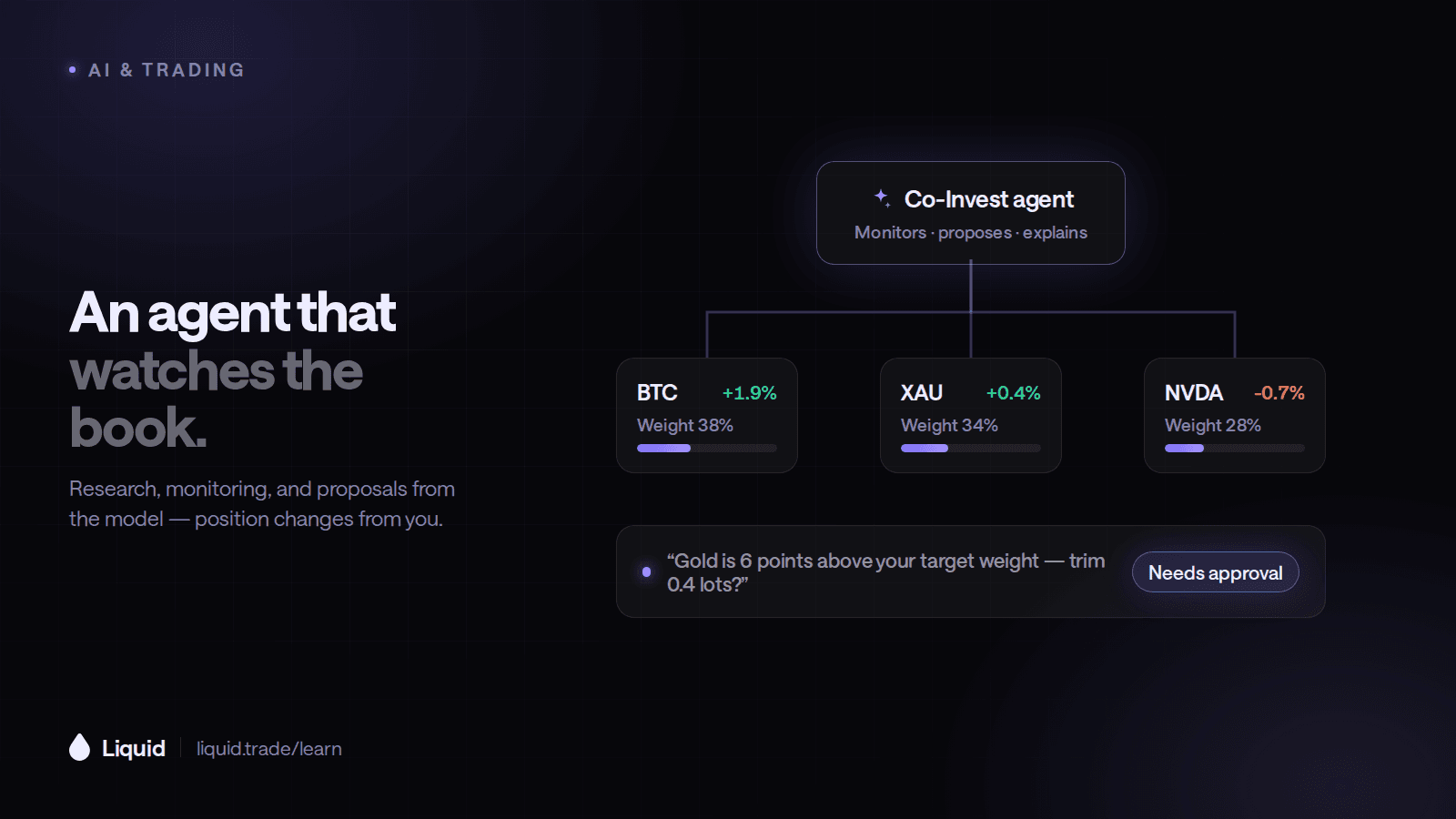
AI & Trading
How to Let an AI Agent Help Manage Your Trading Portfolio
Define what an AI agent may research, propose, and execute. Compare user-confirmed Co-Invest with autonomous Co-Invest Computer and build clear risk limits.
AI & Trading
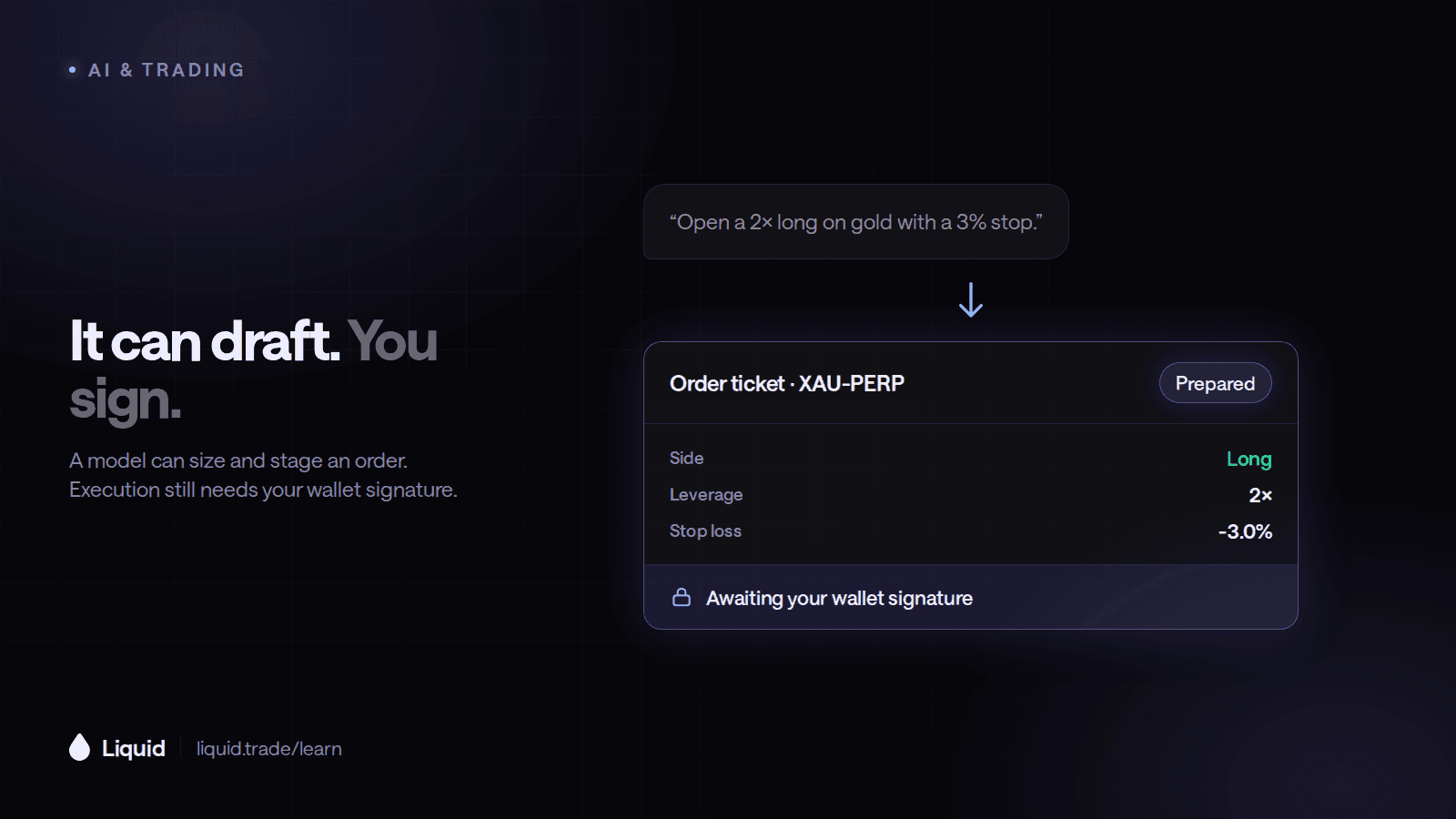
Can You Use ChatGPT to Place Trades?
ChatGPT needs a connected trading service to turn a conversation into an order. Learn how Liquid Co-Invest works and what to check before confirming.
AI & Trading
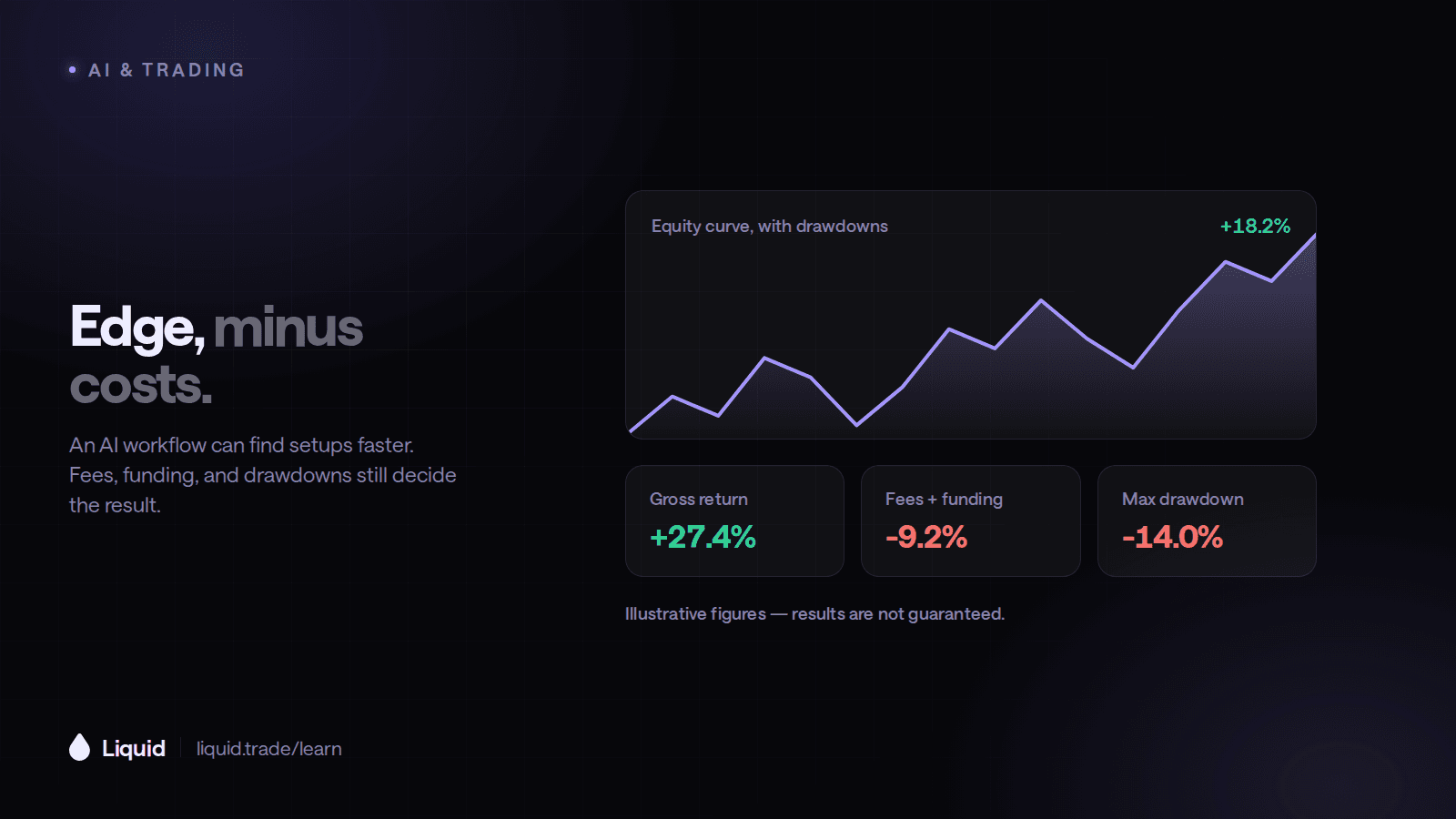
Can You Make Money with AI Trading?
Use AI to research markets, build a repeatable trading process, and evaluate results after costs. Learn how Liquid Co-Invest fits into the workflow.
Put what you learned to work.
Trade crypto, stocks, commodities, FX and pre-IPO names — with multipliers of up to 50×, depending on the market, and instant settlement.