
Leveraged Trading
How Much Leverage Can You Get Trading Gold and Oil?
Gold and oil leverage depends on the contract, venue, and margin. Learn how to compare commodity perpetuals with dated futures and size an example trade.

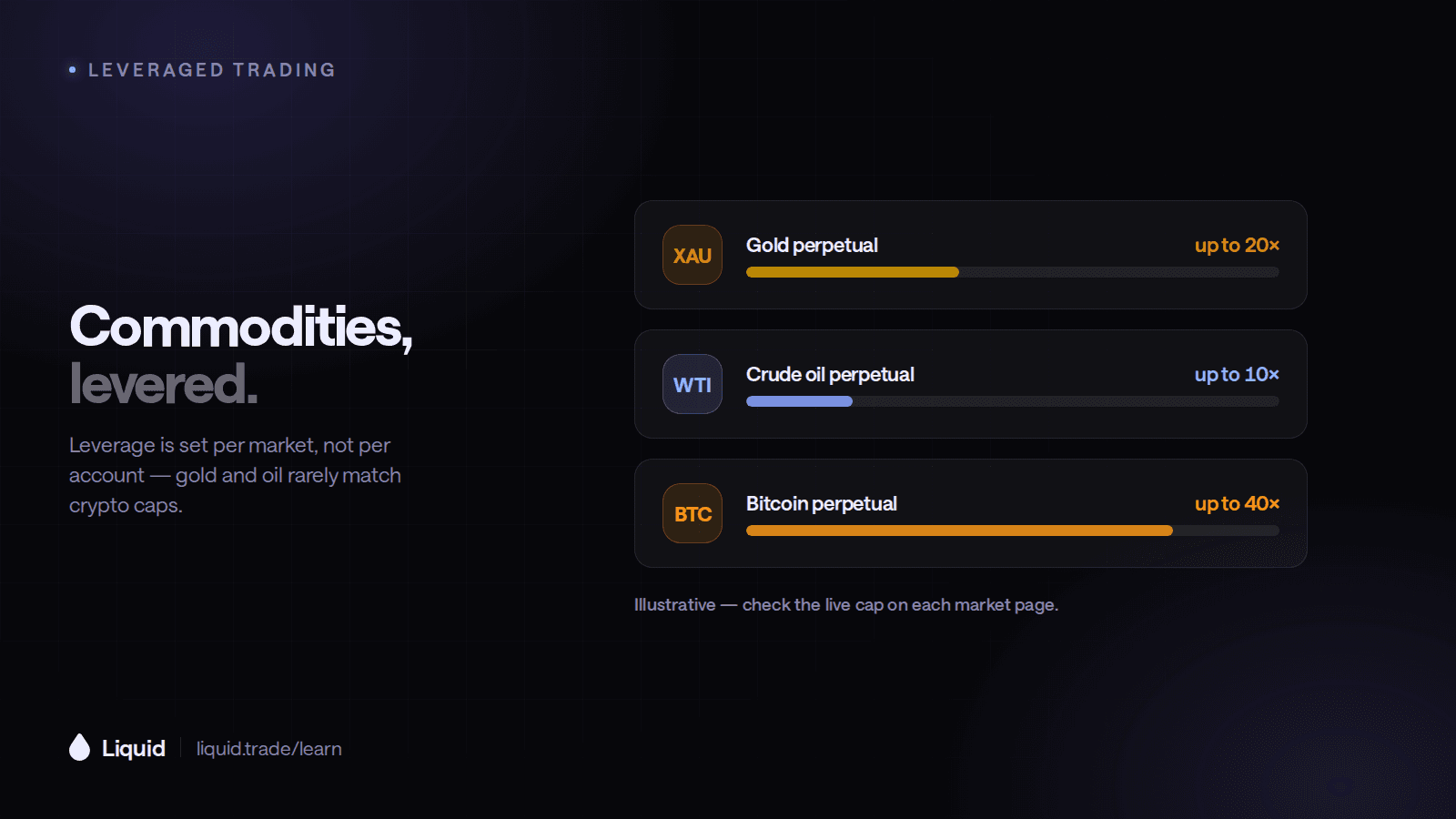
There is no single leverage limit for gold or oil. It depends on whether you trade a perpetual contract, a dated futures contract, or another product, as well as the venue's margin requirements and your position size. Liquid lists gold and oil perpetual exposure; check the selected contract's live order ticket for its available multiplier. Liquid's market overview describes its commodity offering.
Gold and crude oil each have their own contract settings. Start with the commodity you want to trade, then use its available multiplier and margin requirement to plan the position.
How much leverage can I get trading gold and oil?
On a perpetual venue, the contract has a maximum multiplier and margin rules. Liquid's leverage documentation says limits vary by market and can vary by position size. Enter the actual order size to see the applicable requirement.
For exchange-traded futures, calculate effective leverage from the contract's notional value divided by the margin supporting it. The margin is a performance bond rather than a down payment on physical metal or barrels. CME Group explains that requirements differ by product and market volatility. Broker requirements can also affect what you must post.
Effective leverage reflects the current price, required margin, and any additional collateral you maintain. Calculating it from your intended position gives you a more useful number than a general commodity-market headline.
Gold and oil perpetuals versus dated futures
Choose the contract before comparing leverage
Scroll horizontally to compare
| Question | Commodity perpetual | Dated commodity future |
|---|---|---|
| What determines exposure? | The position size and contract reference | Contract count multiplied by contract size and price |
| Does it expire? | No scheduled expiry | Yes; check expiry and settlement rules |
| What supports the position? | Collateral under the venue's margin rules | Margin under exchange and broker requirements |
| What ongoing costs matter? | Applicable funding or other venue carrying charges | Trading costs and costs of rolling to another expiry |
| Do you receive gold or oil? | No physical ownership from the perp | Settlement is contract-specific; delivery rules can matter |
For a concrete size comparison, CME Micro Gold represents 10 troy ounces, while Micro WTI crude oil futures represent 100 barrels. Those units describe CME contracts, not Liquid position minimums or leverage limits. A smaller contract reduces exposure per contract; it does not make a given leverage ratio less sensitive to a percentage price move.
Calculate the exposure before choosing the multiplier
Imagine a hypothetical $2,000 gold perpetual position with $200 of isolated margin. That is 10x leverage. For a linear long position, a 1% rise produces approximately $20 of gross profit, while a 1% fall produces approximately $20 of gross loss. Either move is 10% of starting margin, excluding costs.
With the same $2,000 exposure supported by $400, effective leverage is 5x. The same price move still produces approximately $20 in gross profit or loss, but that is 5% of the larger collateral amount.
The calculation also works for an equivalently sized linear oil contract. Plan each market separately: choose an entry, a level for your planned exit, and a dollar amount you are willing to risk. Those inputs help determine the position size.
If an illustrative $20 loss budget meets a stop 2% from entry, the corresponding notional is $1,000 before allowing for costs and slippage: $20 divided by 0.02. The leverage setting then determines initial margin subject to venue requirements. This sequence connects the position's exposure to a defined trading plan.
What costs should I compare?
Compare the entire intended holding period. That includes entry and exit charges where applicable, spread, slippage, and ongoing carrying costs. Gold and oil can have different fees even on the same app.
Liquid's fee documentation lists different commodity entry fees for Ostium-routed gold and crude oil and a separate Liquid charge. It also distinguishes that route from other venues. The useful number is the total applicable to your order, not one component copied from a comparison table.
For markets using funding payments, rates can change while the position is open. Read how funding rates work and check the current market details when planning a multi-day hold. Include those payments in your estimate of the position's total cost.
Build a gold or oil trade on Liquid
Leveraged positions can be liquidated if equity falls below maintenance requirements, and stop orders can slip. Choose the margin allocation with those mechanics in mind.
Check trading hours and price-reference behavior as well. If you plan to trade outside the reference market's main session, review the current quote and execution conditions. Your order preview is the starting point for evaluating that particular setup.
Inspect gold and oil markets on Liquid → · Plan your stop loss →
Educational content only — not investment advice. Trading perpetual futures involves substantial risk and may not be suitable for every investor. Past performance is not indicative of future results.
Keep reading
All articles →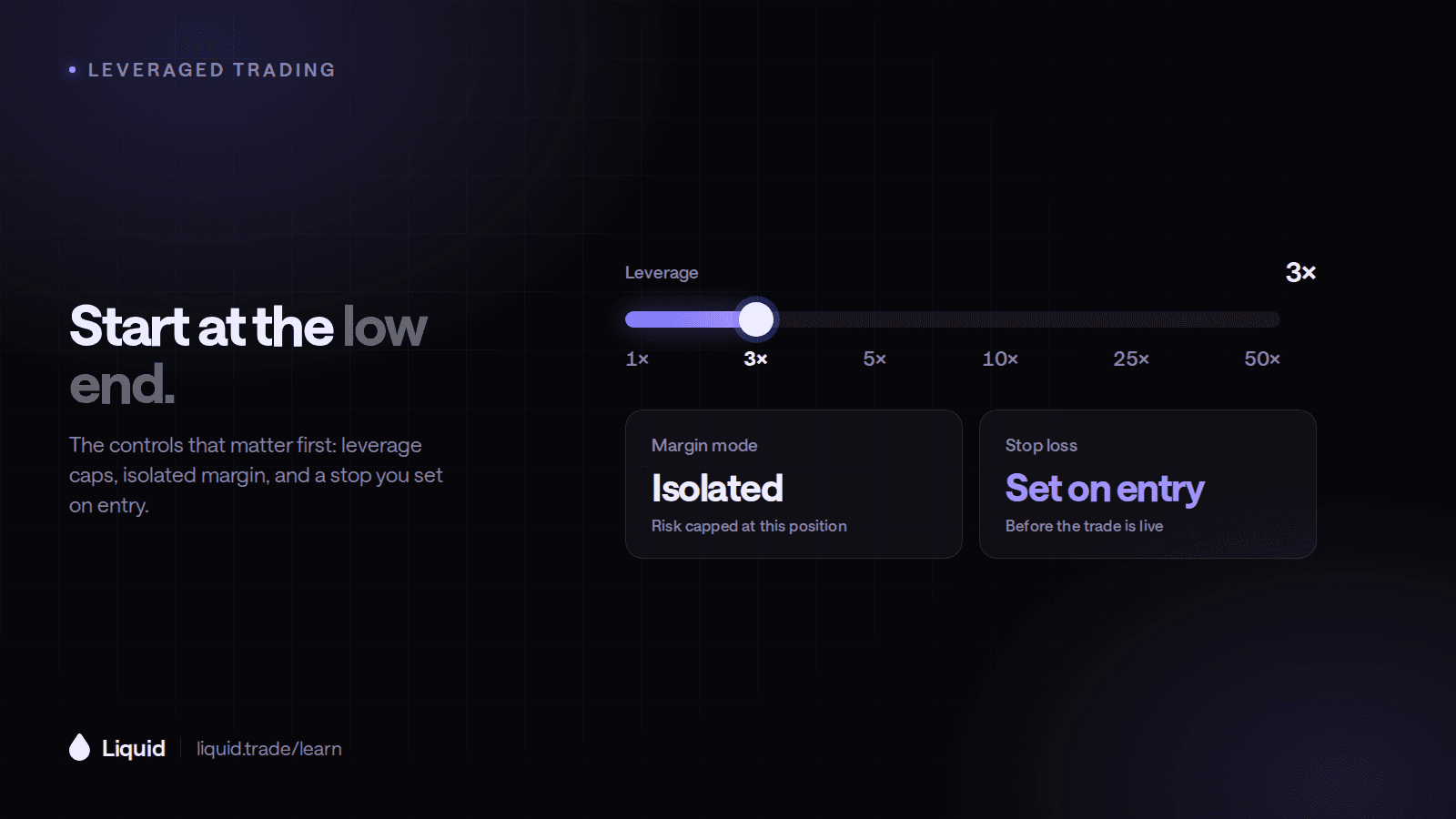
Leveraged Trading
How to Choose a Leverage Trading App as a Beginner
Compare leverage apps by practice tools, clear order previews, costs, and market fit before choosing your first platform.
Leveraged Trading
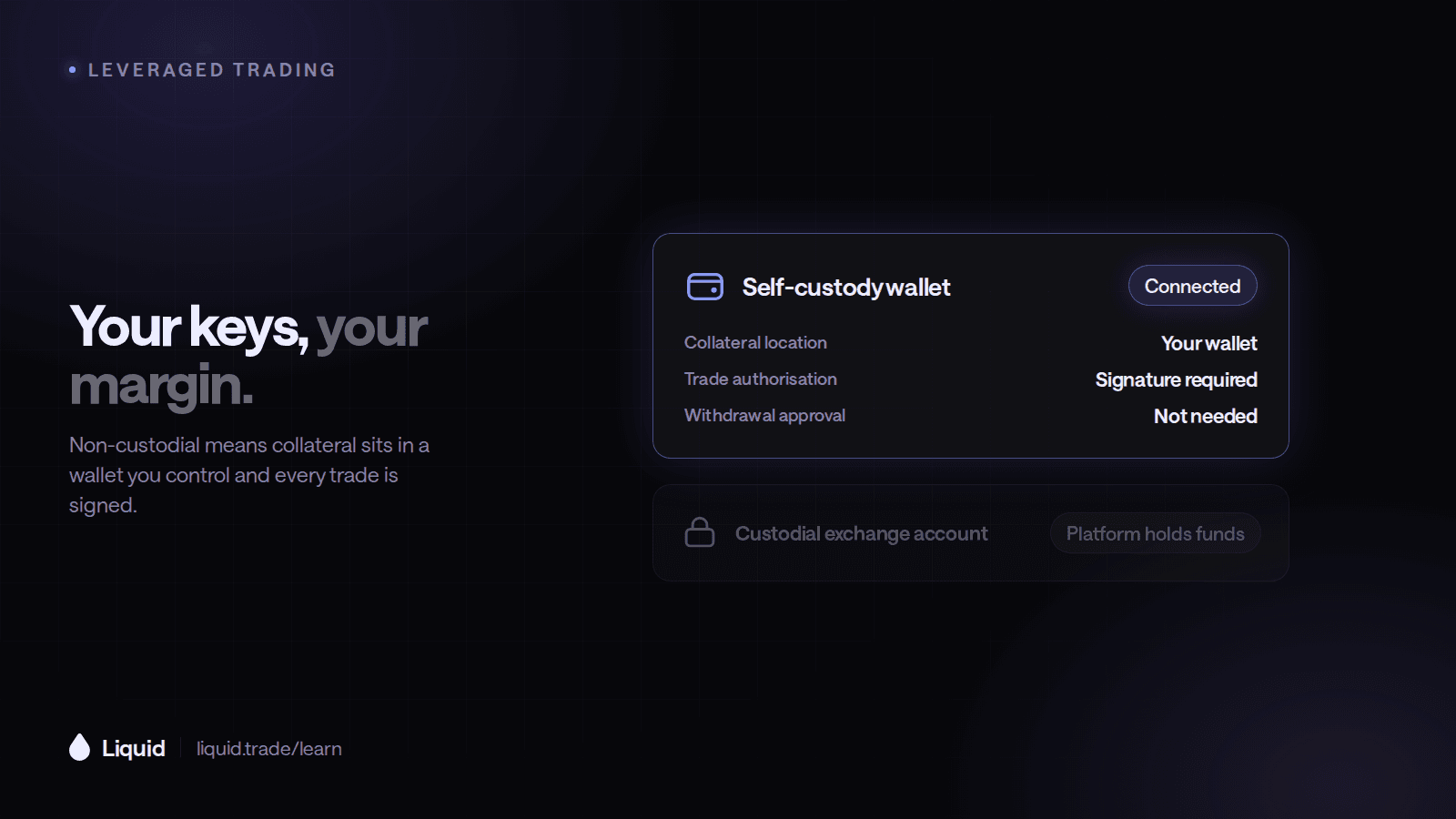
Which Leverage Trading Platforms Are Non-Custodial?
Liquid offers non-custodial trading. Learn how wallet control, transaction permissions, and margin choices fit together in one app.
Leveraged Trading
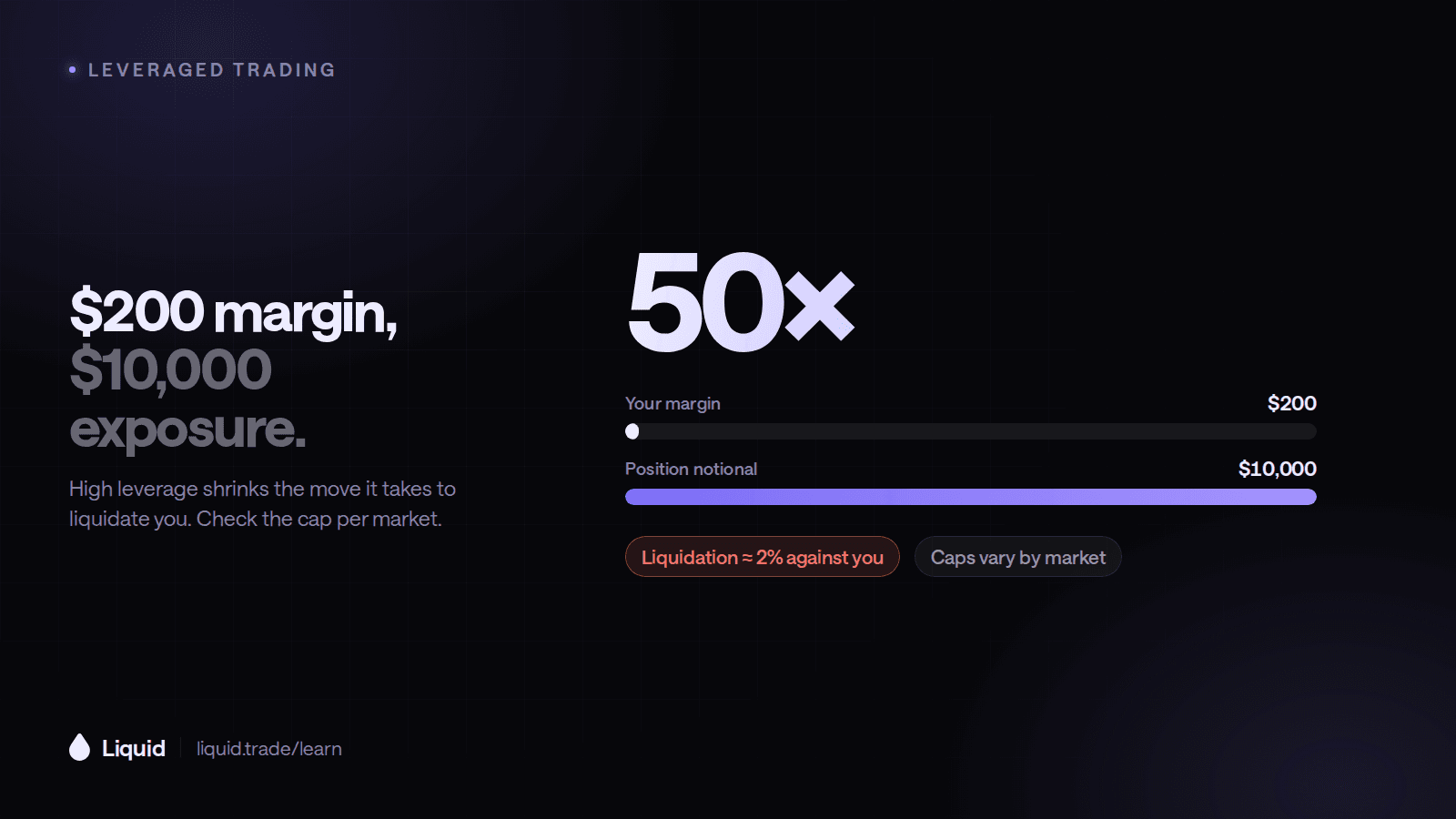
Where Can You Trade with 50x Leverage?
Where Liquid supports 50x leverage, why stock and crypto limits differ, and how position size and margin work together.
Put what you learned to work.
Trade crypto, stocks, commodities, FX and pre-IPO names — with multipliers of up to 50×, depending on the market, and instant settlement.